http://www.swamij.com/hindu-word.htm
About the Words "Hindu" and "Hinduism"
Swami Jnaneshvara Bharati
The words "Hindu" and "Hinduism" are described in different ways by different people. The origins and usages of the terms are not universally agreed upon. As you'll see in the references below, Hindu and Hinduism have been variously used to describe one or another of culture, geography, or religion. Some say that the terms were not used by the indigenous people until fairly recently in history, brought on by foreign peoples and governments, not their own evolution. The original term used for the teachings of the region is Dharma or Sanatana Dharma. There is a movement in the world today to reestablish these terms, either along side of, or instead of the terms "Hindu" and "Hinduism".
http://www.swamij.com/sanatana-dharma-what-is.htm
Below are some quotes on the words "Hindu" and "Hinduism". These references are not intended as academic or scholarly proofs or arguments used to win a debate. Because they are only offered as a most general overview, source information is not included. It is also not intended that any one of these quotes are necessarily more or less authoritative than others, but rather to provide enough discussion that it's easy for the reader to get a feel for the issue. It's easy to find many such references through internet searches and books. Through one's own research and reflection, each person can draw his or her own conclusions about the meanings and uses of the words "Hindu" and "Hinduism," as well as the words "Dharma" and "Sanatana Dharma".
QUOTES:
"The word 'Hindu' occurs nowhere in the classical scriptures of Hinduism. The ancestors of the present day Hindus did not identify themselves as Hindus."
"When Western scholars and Christian missionaries arrived on the scene, the Hindus found their faith tradition 'ism'-ized and its name became 'Hinduism'."
"The word Hindu is not a religious word. It is secular in origin. It is derived from the word Sindhu, which is the name of a major river that flows in the northwestern region of the Indian subcontinent. The ancient Greeks and Armenians used to refer the people living beyond the river Sindhu as Hindus and gradually the name struck. When the Muslims came to the sub continent they called the people living in the region as Hindustanis to distinguish them from the foreign Muslims. Subsequently when the British established their rule, they started calling the local religions collectively under the name of Hinduism."
"Only 180 years ago Raja Ram Mohan Roy coined the word 'Hindu' to describe the huge variety of faiths and sects with similar but not identical philosophies, myths and rituals."
"According to the New Encyclopedia Britannica 20:581, 'Hinduism' was a name given in English language in the Nineteenth Century by the English people to the multiplicity of the beliefs and faiths of the people of the Indus land. The British writers in 1830 gave the word 'Hinduism' to be used as the common name for all the beliefs of the people of India excluding the Muslims and converted Christians."
"According to our ex-President [India] and scholar Dr S Radhakrishnan, the term 'Hindu' had originally a territorial and not credal significance. It implies residence in a well-defined geographical area."
"Surprisingly, though Hinduism is a very ancient religion, the word 'Hinduism', which today defines it and distinguishes it from the rest of the religions, is of much later origin. In ancient India you had either a yogi, a bhakta, a tantric, a sanyasi, a sankhya vadin, a vedantin, a lokayata, a rishi, a muni, a pandit, a pragna, a yogini, a devi, a swami, a Saivite, a Vaishnavite, a siddha or Buddha, but no Hindu."
"The Supreme Court [of India] in the course of deciding an appeal in an election petition, has interpreted the meaning of 'Hindutva' and 'Hinduism' as a "synonym of 'Indianisation' -- i.e. development of uniform culture by obliterating the differences between all all cultures co-existing in the country.' The unanimous judgement given by the three-judge bench consisting of Justices J.S. Verma, N.P. Singh and K. Venkataswami, on December 11, 1995, has quoted earlier Supreme Court judgements and opinions of Dr. S. Radhakrishnan, Dr. Toynbee and others in coming to the conclusion that Hinduism represented a way of life."
"The Supreme Court [of India] bench dealt with the meaning of the word 'Hindutva' or 'Hinduism' when used in election propaganda. The court came to the conclusion that the words 'Hinduism' or 'Hindutva' are not necessarily to be understood and construed narrowly, confined only to the strict Hindu religious practices unrelated to the culture and ethos of the People of India depicting the way of life of the Indian people. Unless the context of a speech indicates a contrary meaning or use, in the abstract, these terms are indicative more of a way of life of the Indian people. Unless the context of a speech indicates a contrary meaning or use, in the abstract, these terms are indicative more of a way of life of the Indian people and are not confined merely to describe persons practicing the Hindu religion as a faith. This clearly means that, by itself, the word 'Hinduism' or 'Hindutva' indicates the culture of the people of India as a whole, irrespective of whether they are Hindus, Muslims, Christians, Jews etc."
"The word 'Hinduism' was coined by European travelers and traders in the 16th century."
"It is interesting to note that the word Hindu is neither Sanskrit nor Dravidian and did not originate in India. It was not used by Indians in their descriptions or writings until the 17th century. If we go by the original definition of the word Hindu, any one who lives in the subcontinent is a Hindu and whatever religion he or she practices is Hinduism. The word Hindu is a secular word and literally translated it means Indian and the word Hinduism denotes any religion or religions that are practiced by the multitude of people living in the land beyond the river Indus."
"It is hard to define Hinduism, let alone defend it. This is the reason when someone asks the question, 'Who is a Hindu or what is Hinduism?' a variety of answers are given. The most appropriate answer perhaps is a long pause and then silence. The confusion that has been propagated in the religion over many centuries has made it prohibitive even to define the word Hinduism."
"Unfortunately Hinduism is represented as monolithic. However, there is no essential Hinduism, no single belief system, and no central authority."
"The Hidden Hindus... include at least 1-2 million non-Indian Americans (Caucasians, African-Americans, Hispanics, etc.) who practice Yoga, meditation, vegetarianism, believe in reincarnation and karma, study the Vedic scriptures, etc., but who –- despite the fact that they are practicing Sanatana Dharma -- will not call themselves 'Hindu', and do not understand that they are part of an ancient and living religious tradition. We need to do everything in our power to bring these two communities together, to bridge this gap".
"That even an atheist may be called a Hindu is an example of the fact that Hinduism is far beyond a simple religious system, but actually an extremely diverse and complicated river of evolving philosophies and ancient traditions."
"It is well known among scholars of South Asian religion that the word 'Hinduism' is a term of convenience--a blanket name for a wide variety of religious practices, beliefs and worldviews that some times have little common ground beyond their Indian origins. Ironically, Hinduism is not an indigenous word to any of the traditions it labels."
"It should be pointed out that the word 'Hindu' is not found in any of the classical writings of India. Nor can it be traced to the classical Indian languages, such as Sanskrit or Tamil. In fact, the word 'Hinduism' has absolutely no origins within India itself. Still, it persists, and traditions as diverse as Shaivism and Jainism, Shaktism and Vaishnavism, have been described as 'Hinduism.' This may work as a matter of convenience, but ultimately it is inaccurate."
"Hinduism has one of the most genetically and ethnically diverse body of adherents in the world. It is hard to classify Hinduism as a religion, as the framework, symbols, leaders and books of reference that make up a typical religion are not uniquely identified in the case of Hinduism. Most commonly it can be seen as a 'way of life' which gives rise to many civilized forms of religions. Hinduism, its religious doctrines, traditions and observances are very typical and inextricably linked to the culture and demographics of India."
"Using the overarching term 'Hinduism' for the many religions of India is comparable to ignoring the different religious orientations within each of the Western traditions, arbitrarily merging them under a single banner—'Semitism' (which, like 'Hinduism,' merely denotes geographical location). Judaism, Christianity, Islam, and other constitute the diverse religious traditions of the Western world. Just as the term Semitism is too broad and reductionistic to represent properly the unique religious manifestation of the great Western traditions, and just as it would be inappropriate to refer to all these traditions as one religion, the term Hinduism falls short."
"The word Hindu is also not mentioned in holy books, Upanishads, Shashtras and Valmiki Ramayan, Shatpath Brahmin Granth etc. And in these holy books there is not any word Hindus or sects or caste system, where as it is clearly mentioned in every chapter of thereof that there is only one God of the Universe."
"According to Jawaharlal Nehru, the earliest reference to the word 'Hindu' can be traced to a Tantrik book of the eighth century C.E., where the word means a people, and not the followers of a particular religion. The use of the word 'Hindu' in connection with a particular religion is of very late occurrence."
"If you examine ancient Indian history and religion, you will find that the word 'Hindu dharma' is not used to describe what is today called 'Hinduism'."
"The word Hindu is relatively modern and is derived from the word Sindhu which means red. The Arabs called the Sindhu river the Indus river since they could not pronounce the S-sound. Thus, the people west of the Sindhu river came to be known as the Hindus and the country got its name India. The original name for the country was Bharata Varsha - the land of Bharata, the king who ruled the country in ancient times. The true name of the religion is Sanatana Dharma. Sanatana means ancient and eternal. Dharma means moral duty. The word Sanatana Dharma connotes a Universal Way of Life for all living entities."
"The word 'hindu' is a non-Indian word, it's origin is Persian/Arabic. It's original meaning is 'dog,' 'low life' or 'slave'."
"The word 'Hindu' means. a liar, a slave, a black, an infidel, in short, a man possessed of every evil to be found in the world; while the term Arya means a pious, a learned, a noble, and a wise man, devoted to the true worship of the Eternal. With this explanation, I dare conclude that no man of common sense would like to be called a Hindu, when once he knows its meaning."
"It should be noted that the word 'Hindu' originally referred to any inhabitant of the Indian subcontinent, or Hind, not followers of the religion as it does now."
"If we see in the four thousand years worth of religious literature in India we cannot find a single reference to the word 'Hinduism' anywhere! 'Hinduism' is a word concocted by Europeans to refer to the myriad streams of religious faiths in the land of Hindustan."
"The word 'Hinduism' itself is a geographical term based upon the Sanskrit name for the great river that runs across the northern boundaries of India, known as the Sindhu."
"The word Hinduism is not found in the 'hindu' religion. In fact there is no such thing as the 'hindu' religion."
"The word 'Hinduism' was introduced in the 19th century to define the aggregate beliefs of the Arya, immigrants who left Central Asia in 1500 BC, and animist religions of native populations in India.""The word 'Hindu' is not found in any Hindu religious text or any other ancient writing. People who lived on the western side of Hindu Kush (killers of Hindus) mountains gave this name to the natives of India. The word Hindu means black, slave, robber, thief and a waylayer."
"Until about 19th century, the term 'Hindu' implied a culture and ethnicity and not religion alone. When the British government started periodic census and established a legal system, need arose to define 'Hinduism' as a clearly-defined religion, along the lines of Christianity or Islam."
"The word 'Hinduism' originated about only 200-300 years ago."
"Beginning around 1000 AD, invading armies from the Middle East called the place beyond the Sindhu 'Hindustan' and the people who lived there the 'Hindus'"
"Today most Western scholars seem resigned to the inconclusiveness of the project of defining Hinduism. Some decline to use the word 'Hinduism' at all, or prefer to use it only in the plural, 'Hinduisms.'"
"At a very early date, Persian explorers entered the Indian subcontinent from the far Northwest. After they returned, they published chronicles. But due to the phonetics of their native Persian language, the 'S' of Sind became an aspirated 'H.' This is how the people of the Indus Valley came to be known generically as "Hindus" by the Persians. This flawed intonation inevitably stuck. And was later re-imported when the invading Moguls conquered India. Since they always referred to the locals as "Hindus," the term was adopted by the Indians themselves as a way of distinguishing native culture from that of the foreign Muslims."
"The word Hinduism was coined by the Muslim scholar Alberuni in the 11th century C.E."
"Various origins for the word 'Hinduism' have been suggested: It may be derived from an ancient inscription translated as: 'The country lying between the Himalayan mountain and Bindu Sarovara is known as Hindusthan by combination of the first letter 'hi' of 'Himalaya' and the last compound letter 'ndu' of the word `Bindu.' Bindu Sarovara is called the Cape Comorin sea in modern times."
"According to the Hindu Scholars, Hinduism is a misnomer and the religion ‘Hinduism’ should be either referred to as ‘Sanatana Dharma’, which means eternal religion, or as Vedic Dharma, meaning religion of the Vedas. According to Swami Vivekananda, the followers of this religion are referred to as Vendantists."
"The word Hinduism is an incorrect nomenclature, which was coined by the British. Thereafter, it has stuck due to the ignorance of its followers. The term 'ism' refers to an ideology that is to be propagated and by any method imposed on others for e.g. Marxism, socialism, communism, imperialism and capitalism but the Hindus have no such 'ism'. Hindus follow the continuum process of evolution; for the Hindus do not have any unidirectional ideology, therefore, in Hindu Dharma there is no place for any 'ism'. Hindus are democratic in approach, for each individual is free to adopt any philosophy or way to self-realization."
http://www.swamij.com/hindu-word.htm
Attaining Yoga or Union:
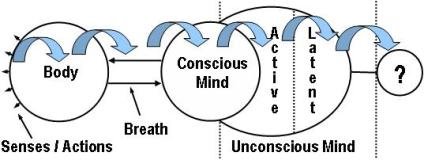
Yoga or "Union" is attained by first training, balancing, and purifying each of the aspects of our being individually, and then systematically receding attention inward through those levels, expanding so as to experience the state of Union, Yoga, Samadhi, or Turiya.
Wednesday, September 27, 2006
Wednesday, September 20, 2006
Living without Two Kinds of IED that Destroy Civilizations and Religions
Living without Two Kinds of IED that Destroy Civilizations and Religions
Swami Jnaneshvara Bharati
We hear much these days from media and leaders of how IEDs or Improvised Explosive Devices are symbols of terrorists trying to destroy civilizations and religions. However, there is another kind of IED that is also extremely destructive, possibly even more destructive historically. It is an IED that the world has cyclically seen used for many centuries, and which seems to be on the rise in recent decades. This IED comes in many disguises, but also has as its goal the destruction of civilizations and religions. This IED is the Insidious Evangelical Device.
The users of this weapon have already successfully destroyed many civilizations and religions throughout Africa, the Americas, Asia, Australia, and Europe over the past thousand or more years. They continue their onslaught today and there is no reason to believe that these IEDs will not continue to be used in the foreseeable future. Sometimes the proponents of this IED even refer to themselves as warriors or crusaders, leaving little room for doubt about their approaches and motives. Unlike an Improvised Explosive Device, which is a mechanical device, a bomb, this IED, the Insidious Evangelical Device, is itself a human being who invades the communities, countries, cultures and civilizations of other people, proselytizing that theirs is the only way.
As a man or woman may have eyes only for his or her own spouse, one may passionately love her or his chosen teacher, deity and religion. However, people thinking that theirs is the only valid, authentic, legitimate or true teacher, deity or religion is like people thinking that theirs is the only valid, authentic, legitimate or true spouse and marriage. When that limited view is coupled with a sense of duty to change and dominate other people, the result can be extremely destructive to civilizations and religions.
Unfortunately, many people of such views are in very high government and corporate positions, and use their power to overtly or covertly maneuver others to carry out their missions. The proselytizing and manipulative conversions are in effect government and corporate sponsored acts of aggression, violence, ignorance and arrogance. These politically powerful people easily navigate through the legal systems and world communities of governments in such a way that they create the appearance that it is others who are the religiously intolerant because of not sanctioning their conversion dogma.
To divert attention from their actions these extremists call the other extremists extreme; the radicals call the radicals radical. Unless wisdom comes to prevail, history may again be repeated, with millions more slaughtered because of these myopic Insidious Evangelical Devices who, although a minority, have a very loud, effective voice of destruction.
Improvised Explosive Devices are vicious weapons that need to be abandoned by the community of humankind. But Insidious Evangelical Devices are also vicious weapons that need to be renounced for the shared benefit of all peoples of the world. If humanity wants the world to be a better place, we will need to first set aside our ignorance and habits of mind that set the stage for both of these forms of IEDs.
People of religions and spiritual traditions that do not participate in conversion need to be more outspoken about this, rather than shrink in silence so as to not offend the proselytizers. People of religions and spiritual traditions that do promote conversions, but do not personally agree with these conversion philosophies, also need to be more outspoken about this, rather than timidly turn a blind eye so as to avoid the fear of being shunned by their religious peers.
All religions, cultures and civilizations evolve over time. Let the followers of the conversion religions, denominations and sects rethink their priorities and set aside their outdated habits, and reclaim the higher spiritual values of accepting and loving all, and excluding none. If there ever was a time in human history when a proselytizing, converting type of religion was of use, that time has passed, as our world has become so small due to communications and transportation.
We must see that we are all trees of the same forest, waves of the same ocean, stars of the same sky, and humans of the same humanity, though we may conceptualize this principle in vastly different ways. This does not mean that we need to merge all the religions into one mega-religion, or all the civilizations into one mega-civilization. Tolerance needs to mean not a mere grudging acceptance of a persistent annoyance, but a loving admiration for the diversity of civilizations and religions that exists within the unity of humanity. This may seem a mere dream, but we humans have done many amazing things that began as only dreams. Maybe through our dreams, devotion and efforts we can learn to live without either kind of IED.
Swami Jnaneshvara Bharati
We hear much these days from media and leaders of how IEDs or Improvised Explosive Devices are symbols of terrorists trying to destroy civilizations and religions. However, there is another kind of IED that is also extremely destructive, possibly even more destructive historically. It is an IED that the world has cyclically seen used for many centuries, and which seems to be on the rise in recent decades. This IED comes in many disguises, but also has as its goal the destruction of civilizations and religions. This IED is the Insidious Evangelical Device.
The users of this weapon have already successfully destroyed many civilizations and religions throughout Africa, the Americas, Asia, Australia, and Europe over the past thousand or more years. They continue their onslaught today and there is no reason to believe that these IEDs will not continue to be used in the foreseeable future. Sometimes the proponents of this IED even refer to themselves as warriors or crusaders, leaving little room for doubt about their approaches and motives. Unlike an Improvised Explosive Device, which is a mechanical device, a bomb, this IED, the Insidious Evangelical Device, is itself a human being who invades the communities, countries, cultures and civilizations of other people, proselytizing that theirs is the only way.
As a man or woman may have eyes only for his or her own spouse, one may passionately love her or his chosen teacher, deity and religion. However, people thinking that theirs is the only valid, authentic, legitimate or true teacher, deity or religion is like people thinking that theirs is the only valid, authentic, legitimate or true spouse and marriage. When that limited view is coupled with a sense of duty to change and dominate other people, the result can be extremely destructive to civilizations and religions.
Unfortunately, many people of such views are in very high government and corporate positions, and use their power to overtly or covertly maneuver others to carry out their missions. The proselytizing and manipulative conversions are in effect government and corporate sponsored acts of aggression, violence, ignorance and arrogance. These politically powerful people easily navigate through the legal systems and world communities of governments in such a way that they create the appearance that it is others who are the religiously intolerant because of not sanctioning their conversion dogma.
To divert attention from their actions these extremists call the other extremists extreme; the radicals call the radicals radical. Unless wisdom comes to prevail, history may again be repeated, with millions more slaughtered because of these myopic Insidious Evangelical Devices who, although a minority, have a very loud, effective voice of destruction.
Improvised Explosive Devices are vicious weapons that need to be abandoned by the community of humankind. But Insidious Evangelical Devices are also vicious weapons that need to be renounced for the shared benefit of all peoples of the world. If humanity wants the world to be a better place, we will need to first set aside our ignorance and habits of mind that set the stage for both of these forms of IEDs.
People of religions and spiritual traditions that do not participate in conversion need to be more outspoken about this, rather than shrink in silence so as to not offend the proselytizers. People of religions and spiritual traditions that do promote conversions, but do not personally agree with these conversion philosophies, also need to be more outspoken about this, rather than timidly turn a blind eye so as to avoid the fear of being shunned by their religious peers.
All religions, cultures and civilizations evolve over time. Let the followers of the conversion religions, denominations and sects rethink their priorities and set aside their outdated habits, and reclaim the higher spiritual values of accepting and loving all, and excluding none. If there ever was a time in human history when a proselytizing, converting type of religion was of use, that time has passed, as our world has become so small due to communications and transportation.
We must see that we are all trees of the same forest, waves of the same ocean, stars of the same sky, and humans of the same humanity, though we may conceptualize this principle in vastly different ways. This does not mean that we need to merge all the religions into one mega-religion, or all the civilizations into one mega-civilization. Tolerance needs to mean not a mere grudging acceptance of a persistent annoyance, but a loving admiration for the diversity of civilizations and religions that exists within the unity of humanity. This may seem a mere dream, but we humans have done many amazing things that began as only dreams. Maybe through our dreams, devotion and efforts we can learn to live without either kind of IED.


Friday, September 15, 2006
Yoga Nidra and Samskaras
QUESTION: After reading your site I have a couple of interrelated questions to pose, With yoga nidra is it possible to select unpleasant samskaras to eliminate rather than any samskara? and how do I witness a specific pre-chosen samskara without accessing pictures / voices / my internal voice?
PARTIAL RESPONSE: If you call up a picture on the monitor of your computer, you can look at the picture. You can open a sound file and listen to it through the speakers. But how would you look at the photo or listen to the sound on the hard drive itself, without a mircroprocessor and without a monitor or speakers? Can you see and hear the bits and bytes of binary language on the hard drive? Similarly, impressions at the causal level, the plane of samskaras, are formless. You are stuck with that confusion. Meditation and contemplation will eventually reveal this to you. Yoga nidra is a method of accessing the causal, formless level. Keep reading the articles and doing the practices and insights will come.
http://www.swamij.com/yoga-nidra.htm
PARTIAL RESPONSE: If you call up a picture on the monitor of your computer, you can look at the picture. You can open a sound file and listen to it through the speakers. But how would you look at the photo or listen to the sound on the hard drive itself, without a mircroprocessor and without a monitor or speakers? Can you see and hear the bits and bytes of binary language on the hard drive? Similarly, impressions at the causal level, the plane of samskaras, are formless. You are stuck with that confusion. Meditation and contemplation will eventually reveal this to you. Yoga nidra is a method of accessing the causal, formless level. Keep reading the articles and doing the practices and insights will come.
http://www.swamij.com/yoga-nidra.htm
Thursday, September 14, 2006
Witnessing and the Self
QUESTION: I would like to ask you a clarifying question regarding witnessing. Is the world of objects, experienced through the senses, a projection of the Self within? In another words, is what is seen, heard, touched, smelled and tasted a projection from the Self? A projection that goes through the various layers of ones being, is tinted by those layers, and flows outward through the senses. And when this projection flows outward, for example I look and see a tree, this projection stirs some memories in Chitta and then the Self get all caught up with the memories brought on by the projection of the tree. As a result does the Self get all caught up with it own projections? However, when witnessing, is the Self stepping back and witnessing both the objects of the world and the thoughts that arise from Chitta? Is this what is happening when I look at the world around me and at the same time witness the thoughts flowing through the mind?
PARTIAL RESPONSE: There are two aspects to this, of which one is more important than the other. First, the projection outward. Technically true, but can sound like so much wordy philosophy. Leaves one bewiledered about how "I" made all this mess. The other part is systematically stepping back inward. That is the sadhana that reveals the process, and which eventually reveals the Self. Then it makes sense about the projection part. We look out as if through the many lenses inside of a long telescope. The object is seen by the lens called physical eyes; that by the lens of mental "eye"; that by the lens of mind; that by the lens of intelligence; that by the lens of individuation, and then, finally the Self. It's tough philosophy, yet elegantly simple.
PARTIAL RESPONSE: There are two aspects to this, of which one is more important than the other. First, the projection outward. Technically true, but can sound like so much wordy philosophy. Leaves one bewiledered about how "I" made all this mess. The other part is systematically stepping back inward. That is the sadhana that reveals the process, and which eventually reveals the Self. Then it makes sense about the projection part. We look out as if through the many lenses inside of a long telescope. The object is seen by the lens called physical eyes; that by the lens of mental "eye"; that by the lens of mind; that by the lens of intelligence; that by the lens of individuation, and then, finally the Self. It's tough philosophy, yet elegantly simple.
Friday, August 25, 2006
Who's Driving Your Chariot?
WHO'S DRIVING YOUR CHARIOT?
Swami Jnaneshvara
The chariot is used by the ancient sages as a symbol for how to train
your mind and senses. Though most of us do not use horse drawn
chariots, the lesson is as practical today as it was thousands of
years ago. Allow your mind to visualize this image, and it will
become a wonderful tool in your daily spiritual life.
ROADS: The many roads down which the chariot may travel are the
countless objects of desire in the world and our memory.
HORSES: The ten horses are the ten senses (indriyas) through which we relate to the external world by perception and action.
REINS: The reins are the mind (manas) through which the sensesreceive their instructions to act and perceive.
CHARIOTEER: The charioteer is the higher intellect (buddhi), which issupposed to be the wise giver of instructions to the mind.
PASSENGER: The passenger is the Self, the Atman, the pure center ofconsciousness, which is always the neutral witness. (See koshas)
CHARIOT: The chariot itself is the physical body, the instrumentthrough which the Self, intellect, mind, and senses operate.
WHO'S DRIVING YOUR CHARIOT?
For many of us, much of the time, the charioteer is not on duty. Thereins called mind are flapping around freely without the properguidance of our inner wisdom. When the reins are free, they give noinstructions to the horses called senses. The horses (senses) roamfreely down any road they feel pulled towards in the moment, inresponse to their memories of the past (chitta). The chariot (body)takes a beating, the horses (senses) get tired, the reins (mind) getfrayed, and the charioteer (intelligence) gets lazy. The passenger iscompletely ignored.
PUT THE CHARIOTEER BACK ON THE JOB
The solution to the problem is to retrain the charioteer(intelligence) to pick up the reins (mind) and start giving somedirection to the horses (senses). This training is called sadhana, orspiritual practices. It means training all of the levels of ourselvesso that we might experience the still, silent, eternal center.
ALLOW THE CHARIOTEER TO SERVE THE PASSENGER
As the charioteer (intelligence) becomes more stabilized in beingback on the job, there is an ever increasing awareness of the factthe the entire purpose of the chariot, horses, reins, and charioteer,are to serve as instruments for the passenger, the true Self.
SEE ALSO:
Coordinating the Four Functions of Mind
Training the Ten Senses or Indriyas
Self, Five Koshas or Sheaths
Also on an AUDIO podcast through these links:
SwamiJ.com podcast page / Direct link to sound
iTunes / Yahoo.com / Podcast.net / Odeo.com
(Podcast.com, iTunes, Yahoo.com, and Odeo.com may take some time to update. )
Swami Jnaneshvara
The chariot is used by the ancient sages as a symbol for how to train
your mind and senses. Though most of us do not use horse drawn
chariots, the lesson is as practical today as it was thousands of
years ago. Allow your mind to visualize this image, and it will
become a wonderful tool in your daily spiritual life.
ROADS: The many roads down which the chariot may travel are the
countless objects of desire in the world and our memory.
HORSES: The ten horses are the ten senses (indriyas) through which we relate to the external world by perception and action.
REINS: The reins are the mind (manas) through which the sensesreceive their instructions to act and perceive.
CHARIOTEER: The charioteer is the higher intellect (buddhi), which issupposed to be the wise giver of instructions to the mind.
PASSENGER: The passenger is the Self, the Atman, the pure center ofconsciousness, which is always the neutral witness. (See koshas)
CHARIOT: The chariot itself is the physical body, the instrumentthrough which the Self, intellect, mind, and senses operate.
WHO'S DRIVING YOUR CHARIOT?
For many of us, much of the time, the charioteer is not on duty. Thereins called mind are flapping around freely without the properguidance of our inner wisdom. When the reins are free, they give noinstructions to the horses called senses. The horses (senses) roamfreely down any road they feel pulled towards in the moment, inresponse to their memories of the past (chitta). The chariot (body)takes a beating, the horses (senses) get tired, the reins (mind) getfrayed, and the charioteer (intelligence) gets lazy. The passenger iscompletely ignored.
PUT THE CHARIOTEER BACK ON THE JOB
The solution to the problem is to retrain the charioteer(intelligence) to pick up the reins (mind) and start giving somedirection to the horses (senses). This training is called sadhana, orspiritual practices. It means training all of the levels of ourselvesso that we might experience the still, silent, eternal center.
ALLOW THE CHARIOTEER TO SERVE THE PASSENGER
As the charioteer (intelligence) becomes more stabilized in beingback on the job, there is an ever increasing awareness of the factthe the entire purpose of the chariot, horses, reins, and charioteer,are to serve as instruments for the passenger, the true Self.
SEE ALSO:
Coordinating the Four Functions of Mind
Training the Ten Senses or Indriyas
Self, Five Koshas or Sheaths
Also on an AUDIO podcast through these links:
SwamiJ.com podcast page / Direct link to sound
iTunes / Yahoo.com / Podcast.net / Odeo.com
(Podcast.com, iTunes, Yahoo.com, and Odeo.com may take some time to update. )
Saturday, August 19, 2006
Money, Sex, Fame, Health, Self and Yoga
From this webpage:
http://www.swamij.com/money-sex-fame-health-yoga.htm
It is also on an AUDIO podcast, which can be accessed through any of the following links:
SwamiJ.com podcast page
iTunes
Yahoo.com
Podcast.net
Odeo.com
(You can subscribe to the podcast through iTunes, Podcast.net, Yahoo.com, and Odeo.com. The podcast sites take up to 24 hours to post, and may not be updated at the time you are reading this blog. )
MONEY, SEX, FAME, HEALTH, SELF AND YOGA
Swami Jnaneshvara
Everybody wants happiness. However, we usually seek it in ways that are dependent on external stimulus, as if an outer cause leads to an inner effect of happiness. Surely this process of stimulus-response works to some degree; we have all experienced this in different ways, where getting what we want seems to make us feel good, and not getting what we want seems to make us feel bad. However, what if we knew how to be happy without any stimulus whatsoever? What if you could just rest in the deepest feeling of joy, regardless of the external circumstances?
There seems to be two polarities. Either we think we don't have enough money, or we are striving to have more so as to feel secure and affluent, pursuing what has come to be sold as prosperity or abundance consciousness. Either we don't have a good relationship, or we seek to find the ideal partner so that we will feel whole, complete and needed. Either we feel lonely and unknown, or we strive to be famous in some way, to receive accolades in our personal or professional lives from our family, friends, peers, or community, so as to feel exuberant with pride. Either we have questionable health or active disease, doing little for our body with diet or exercise, or we ardently pursue physical fitness and battle disease so as to feel the satisfaction of conquering the body.
It often appears that there only these two polarities and that we have no other choice but these two. Either we stay stuck where we are, or we seek these seemingly higher goals. It is extremely common for people to use "spiritual" methods such as meditation, contemplation, prayer and mantra to attain these goals. There are many lectures, seminars, books, video and audio programs on how to do this. We are repeatedly told that we can have anything we want, that all we have to do is visualize it, and the universe or God will provide it for us. It is very easy to not see the ego drive behind this approach to spiritual life. It means we are measuring spiritual success by our bank account, sex life, popularity and physical situation. It doesn't take a great deal of reflection to see that these are reframes of attachment, hedonism or greed, which have generally been seen as obstacles to attenuate, rather than goals to be attained.
However, there is a third choice, which is far beyond this oversimplified perspective of having or not having the objects or circumstances of our desire world. There is a way of being, a higher goal, that has nothing to do with whether our desires are, or are not fulfilled. In fact, it completely transcends the issue of desire. This is not to suggest that one should starve in poverty, grieve with loneliness, mourn in desolation, or suffer in physical pain.
Imagine for a moment that you were in such a state of mind that you always felt complete, regardless of whether or not you have any money at all. Imagine for a moment that you truly felt whole, with or without any other partner being in your life. Imagine for a moment that you felt at complete peace, even if no person had ever heard of your name or accomplishments. Imagine for a moment that you were in constant contact with that level of your being that was never born, is not and cannot be diseased, and can never die, and is not subject to any other of the impermanent vagaries of the physical body. To know the Self, the Atman or Purusha, the center of consciousness is to rest in the awareness of, to realize that which is beyond all of these surface level sufferings. It is to seek the awareness of the pre-existing wholeness or union that is sometimes called Yoga.
This can sound like a campaign promoting poverty, loneliness, isolation and decay. Those promoting the worldly solutions will often sell their wares in this way, by saying that words such as these are designed to leave people where they are, or to be miserable in life, as if these words are suggesting some future afterlife will be more fulfilling. This is very far from the message of pursuing Self-Realization. One who seeks to know the eternal, pure, ever-joyous center of consciousness can easily live in the world, and enjoy the objects of the world at the same time. Such a person can and will naturally have all that is needed, will have close relationships, will have active and enriching engagement with the community, and will naturally move toward physical health and well being. However, those are not the goals, but are the natural byproducts of sincerely, passionately seeking that single higher goal.
Mind is very tricky. It will try to reason that, "Okay, so to get money, sex, fame and health I need to pursue enlightenment. Good, let me do that, so that I get what I want." That is a game of the mind. The primary goal of seeking the direct experience of that eternally joyous center of consciousness is being skipped over once again, in the name of the lesser goals. However, one who repeatedly seeks that single, higher goal, by whatever name you choose to call it, will find that those secondary goals come easily. They become pleasant experiences of life, but can have no effect whatsoever on whether "I" am feeling "good" or "I" am feeling "bad." One who knows the Self, the Atman can live in the world, but yet be above the world. Even for one who has not attained permanent awareness of this Self, which is the Self of all, but who is consciously, persistently, though gently pursuing it, will find that the other pleasures will come, resting on the foundation of the higher.
This is so elegantly simple and profoundly practical, bringing such grand results, that it can be repeatedly overlooked. By being ever mindful that the highest joy is already there, in the inner chamber of our being, in fact, being who we really are, life becomes very straightforward and happy. Moving towards this one goal brings many fruits along the way. Life becomes poetry and song, filled with joy. And one day, when least expected, when, in a moment, there is no expectation at all, the Self, Truth, or God is revealed, and that leaves all of the other pleasant experiences pale by comparison to this which is incomparable and inexplicable.
http://www.swamij.com/money-sex-fame-health-yoga.htm
It is also on an AUDIO podcast, which can be accessed through any of the following links:
SwamiJ.com podcast page
iTunes
Yahoo.com
Podcast.net
Odeo.com
(You can subscribe to the podcast through iTunes, Podcast.net, Yahoo.com, and Odeo.com. The podcast sites take up to 24 hours to post, and may not be updated at the time you are reading this blog. )
MONEY, SEX, FAME, HEALTH, SELF AND YOGA
Swami Jnaneshvara
Everybody wants happiness. However, we usually seek it in ways that are dependent on external stimulus, as if an outer cause leads to an inner effect of happiness. Surely this process of stimulus-response works to some degree; we have all experienced this in different ways, where getting what we want seems to make us feel good, and not getting what we want seems to make us feel bad. However, what if we knew how to be happy without any stimulus whatsoever? What if you could just rest in the deepest feeling of joy, regardless of the external circumstances?
There seems to be two polarities. Either we think we don't have enough money, or we are striving to have more so as to feel secure and affluent, pursuing what has come to be sold as prosperity or abundance consciousness. Either we don't have a good relationship, or we seek to find the ideal partner so that we will feel whole, complete and needed. Either we feel lonely and unknown, or we strive to be famous in some way, to receive accolades in our personal or professional lives from our family, friends, peers, or community, so as to feel exuberant with pride. Either we have questionable health or active disease, doing little for our body with diet or exercise, or we ardently pursue physical fitness and battle disease so as to feel the satisfaction of conquering the body.
It often appears that there only these two polarities and that we have no other choice but these two. Either we stay stuck where we are, or we seek these seemingly higher goals. It is extremely common for people to use "spiritual" methods such as meditation, contemplation, prayer and mantra to attain these goals. There are many lectures, seminars, books, video and audio programs on how to do this. We are repeatedly told that we can have anything we want, that all we have to do is visualize it, and the universe or God will provide it for us. It is very easy to not see the ego drive behind this approach to spiritual life. It means we are measuring spiritual success by our bank account, sex life, popularity and physical situation. It doesn't take a great deal of reflection to see that these are reframes of attachment, hedonism or greed, which have generally been seen as obstacles to attenuate, rather than goals to be attained.
However, there is a third choice, which is far beyond this oversimplified perspective of having or not having the objects or circumstances of our desire world. There is a way of being, a higher goal, that has nothing to do with whether our desires are, or are not fulfilled. In fact, it completely transcends the issue of desire. This is not to suggest that one should starve in poverty, grieve with loneliness, mourn in desolation, or suffer in physical pain.
Imagine for a moment that you were in such a state of mind that you always felt complete, regardless of whether or not you have any money at all. Imagine for a moment that you truly felt whole, with or without any other partner being in your life. Imagine for a moment that you felt at complete peace, even if no person had ever heard of your name or accomplishments. Imagine for a moment that you were in constant contact with that level of your being that was never born, is not and cannot be diseased, and can never die, and is not subject to any other of the impermanent vagaries of the physical body. To know the Self, the Atman or Purusha, the center of consciousness is to rest in the awareness of, to realize that which is beyond all of these surface level sufferings. It is to seek the awareness of the pre-existing wholeness or union that is sometimes called Yoga.
This can sound like a campaign promoting poverty, loneliness, isolation and decay. Those promoting the worldly solutions will often sell their wares in this way, by saying that words such as these are designed to leave people where they are, or to be miserable in life, as if these words are suggesting some future afterlife will be more fulfilling. This is very far from the message of pursuing Self-Realization. One who seeks to know the eternal, pure, ever-joyous center of consciousness can easily live in the world, and enjoy the objects of the world at the same time. Such a person can and will naturally have all that is needed, will have close relationships, will have active and enriching engagement with the community, and will naturally move toward physical health and well being. However, those are not the goals, but are the natural byproducts of sincerely, passionately seeking that single higher goal.
Mind is very tricky. It will try to reason that, "Okay, so to get money, sex, fame and health I need to pursue enlightenment. Good, let me do that, so that I get what I want." That is a game of the mind. The primary goal of seeking the direct experience of that eternally joyous center of consciousness is being skipped over once again, in the name of the lesser goals. However, one who repeatedly seeks that single, higher goal, by whatever name you choose to call it, will find that those secondary goals come easily. They become pleasant experiences of life, but can have no effect whatsoever on whether "I" am feeling "good" or "I" am feeling "bad." One who knows the Self, the Atman can live in the world, but yet be above the world. Even for one who has not attained permanent awareness of this Self, which is the Self of all, but who is consciously, persistently, though gently pursuing it, will find that the other pleasures will come, resting on the foundation of the higher.
This is so elegantly simple and profoundly practical, bringing such grand results, that it can be repeatedly overlooked. By being ever mindful that the highest joy is already there, in the inner chamber of our being, in fact, being who we really are, life becomes very straightforward and happy. Moving towards this one goal brings many fruits along the way. Life becomes poetry and song, filled with joy. And one day, when least expected, when, in a moment, there is no expectation at all, the Self, Truth, or God is revealed, and that leaves all of the other pleasant experiences pale by comparison to this which is incomparable and inexplicable.
Thursday, July 20, 2006
The Secret of Shiva and Shakti
From this webpage:
http://www.swamij.com/shiva-shakti-secret.htm
It is also on an AUDIO podcast, which can be accessed through any of the following links:
SwamiJ.com podcast page
iTunes
Yahoo.com
Podcast.net
Odeo.com
(You can subscribe to the podcast through iTunes, Podcast.net, Yahoo.com, and Odeo.com.)
THE SECRET OF SHIVA AND SHAKTI
Swami Jnaneshvara
Shiva and Shakti are one and the same.
There is no place that He is not.
There is no place that She is not.
They are one and the same.
She is in every thing.
She is in every word.
She is all there is.
See Her in all things.
Hear Her in all sounds.
Know Her in all thoughts.
Feel Her in all feelings.
She is all there is.
She is the one in the three worlds.
Shiva and Shakti are one and the same.
That is the secret.
http://www.swamij.com/shiva-shakti-secret.htm
It is also on an AUDIO podcast, which can be accessed through any of the following links:
SwamiJ.com podcast page
iTunes
Yahoo.com
Podcast.net
Odeo.com
(You can subscribe to the podcast through iTunes, Podcast.net, Yahoo.com, and Odeo.com.)
THE SECRET OF SHIVA AND SHAKTI
Swami Jnaneshvara
Shiva and Shakti are one and the same.
There is no place that He is not.
There is no place that She is not.
They are one and the same.
She is in every thing.
She is in every word.
She is all there is.
See Her in all things.
Hear Her in all sounds.
Know Her in all thoughts.
Feel Her in all feelings.
She is all there is.
She is the one in the three worlds.
Shiva and Shakti are one and the same.
That is the secret.
Subscribe to:
Posts (Atom)


