WHAT GOD IS
Swami Rama
All the religions of the world have been promising the vision of God, mental peace, salvation, and many kinds of temptations to their followers, but so far nothing has come true. The more that people are involved in sectarian religious activities, the more likely they are to become disappointed because of frustrated expectations of God and religion. Many preachers claim that if their teachings are followed without question, believers will find salvation. But after they return from their church or temple, they are frequently more stressed, frustrated, and worried about their problems than are “non-believers.”
Mere belief in God alone does not satisfy the students of life who are searching for Ultimate Truth. Suppose a student believes in the existence of God but is not emotionally mature and does not have a peaceful mind. Such a student does not have tranquility and equanimity, which are the main prerequisites for enlightenment. On the path of enlightenment, it is necessary to have control over the senses and mind, but it is not necessary to have belief in God. Enlightenment is a state of freedom from the ignorance that causes suffering, and attaining this is the prime necessity of every human life. There is no necessity to attain mere belief in God, but it is necessary to have profound knowledge of the truth which lies behind the concept of the word God.
The word G-O-D is not God. The religionists, because they superimpose their own limited fantasies upon the truth and call it God, suffer more than the people who do not believe in the concept of God. If Ultimate Truth is called God, then there is no difficulty. Then it can be practiced with mind, action, and speech, and once the truth is known with mind, action, and speech, knowledge is complete. But having faith in the fantasies of the religionists creates limited boundaries for the human intellect and leads to a religious atmosphere in which the poor followers must suffer until the last breaths of their lives.
Though religious dogma tempts the human mind with promises of the vision of God, it does not clarify and define the concept of God. The way religious books present the picture of God is injurious to human growth, for one who believes in God without understanding what God really is, closes the door to further knowledge and learning and cannot experience the inner dimensions of life. Such false promises are strongly discouraged in the Upanishads, which warn, “Neti, neti—not this, not this.” The student is made aware of the need to understand the reality and is encouraged to search for truth within. The Upanishads inspire one first to know oneself and then to know the Self of all. Upanishadic literature makes one aware that every being embodied in a physical sheath is a moving shrine of Supreme Consciousness. It also provides methods for entering the inner shrine, wherein shines the infinite light of knowledge, peace, and happiness.
Prayer is a major technique used by religionists to seek satisfaction of their desires and comfort in spite of their frustrations. Many people who are not acquainted with the basic principles of Vedantic philosophy think that there are prayers in the Upanishadic literature. For example: "Lead me from the unreal to the Real; lead me from darkness to Light; lead me from mortality to Immortality" may bethought to be a prayer. But it is actually an expression of the aspirant's spiritual desires that remind him of his goal of life constantly. It is not a prayer but a way of maintaining constant awareness of Supreme Consciousness. It is not asking God or any supernatural being to help one or to lead one to the higher states. The idea is not to know God as a different being, but to know one's own real Self and its essential nature, which is the Self of all. One is not attaining something that is not already there but is realizing that which is self-existent. This Upanishadic verse is not a prayer asking for anything but a way of strengthening constant awareness of Supreme Consciousness which is the goal of the Upanishads.
Dualism is the preliminary experience of a contemplative mind. All religions suffer on account of dualistic concepts, such as "Human beings are a creation of God; the universe is a creation of God; human beings have no choice but to suffer and should delight in their sufferings at the mercy of God." These concepts are illogical when they are analyzed with clarity of mind and pure reason. In the course of study, a student first experiences dualism—the reality that he exists and the Supreme Consciousness also exists. Then a state comes when he experiences "Thou art That." These two fields of experience appear to be different, but they are essentially one and the same. These are the progressive states that aspirants experience, but as far as Absolute Reality is concerned, there is only one without second.
Religionists say the ultimate goal of human life is to know God, and materialists say it is to eat, drink, and be merry. But the philosophy of the Upanishads asserts that the ultimate goal is to be free from all pain and misery whatsoever. This state of freedom from anxieties, misery, and ignorance is called enlightenment. It is the union of the individual with Universal Consciousness. Religionists say that one has to have faith in the sayings of the scriptures and in the way they are preached. But in Upanishadic philosophy; the mind is released from all religious prejudices so then one can think and reason freely. The Upanishads declare that even the best of intellects is incapable of fathoming the unfathomable, and that learning the scriptures is not the ultimate way of realization. On the path of enlightenment, even the lust for learning must eventually be abandoned.
In some of the Upanishads, the word Īśa or Īśvara, which is roughly translated as God, appears. But the concept of God as preached by religion is not found in the Upanishads. In the Upanishads, the word Īśvara is used to denote a state of collective consciousness. Thus, God is not a being that sits on a high pedestal beyond the sun, moon, and stars; God is actually the state of Ultimate Reality. But due to the lack of direct experience, God has been personified and given various names and forms by religions throughout the ages. When one expands one's individual consciousness to the Universal Consciousness, it is called Self-realization, for the individual self has realized the unity of diversity, the very underlying principle, or Universal Self, beneath all forms and names. The great sages of the Upanishads avoid the confusions related to conceptions of God and encourage students to be honest and sincere in their quests for Self-realization. Upanishadic philosophy provides various methods for unfolding higher levels of truth and helps students to be able to unravel the mysteries of the individual and the universe.
Knowledge of Brahmavidyā, the direct experience of Supreme Consciousness, is the common theme of all Upanishadic literature. "I am Brahman; the whole universe is Brahman; Thou art That"—such statements are the foundations for all its theories, principles, and practices. All philosophical and psychological discussions are meant to make students aware of their true nature—Brahman, the Supreme Consciousness. For a realized one, there is perennial joy in the universe, but for the ignorant there is only misery everywhere. The moment a student realizes his essential nature, the darkness of ignorance is dispelled, but before that the individual mind travels to the groove of self-created misery and thus projects the belief that there is misery everywhere. In reality, this universe is like a great poem of joy, a beautiful song, and a unique work of art. The moment one unfolds and realizes one's human capacity and ability, one becomes aware that, "Thou art that—Brahman."
Here lies the difference between a Self-realized person and a religionist. The religionist does not know and yet believes in God, but the realized person is directly aware of the self-existent Ultimate Reality of life and the universe. First, he knows the truth, and then he believes it. If God is the Ultimate Truth hidden behind many forms and names, then it should be realized, and, for realizing the Truth with mind, action, and speech, one needs to practice truth rather than being a hypocrite and a fanatic. It is not necessary to believe in God to attain self-enlightenment, but it is very necessary to know the various levels of consciousness and finally to realize the ultimate source. The manifest aspect and the unmanifest aspect of consciousness (Brahman) should be realized, for that alone can enlighten aspirants.
http://swamij.com
Attaining Yoga or Union:
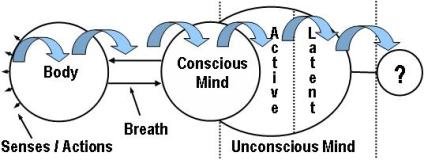
Yoga or "Union" is attained by first training, balancing, and purifying each of the aspects of our being individually, and then systematically receding attention inward through those levels, expanding so as to experience the state of Union, Yoga, Samadhi, or Turiya.
Sunday, May 13, 2007
Yoga Meditation, Electricity and Computers
Yoga Meditation, Electricity and Electricity
From:
http://www.swamij.com/computers-consciousness.htm
I AM THE ELECTRICITY
Swami Jnaneshvara
I am not the picture on my computer monitor;
I am electricity.
I am not the processing in my microchip;
I am electricity.
I am not the data on my hard drive;
I am electricity.
I am electricity;
I am the life in all of these others.
A MODEL FOR MEDITATION:
The computer can be used as a modern metaphor for understanding the
process of Yoga meditation and the levels of consciousness through
which one journeys. By understanding these levels or stages, it is
much easier to understand how meditation is not used merely as a
means of relaxation or psychic experience, but as the means for the
realization of the ever pure, ever joyful core of our being, by
whatever name you choose to call that center.
1) PERIPHERALS/CONSCIOUS:
The ten senses and means of expression (indriyas), along with the
conscious mind, allow the inner person to communicate and act in the
external world, like the peripherals of a computer system, including
monitor, keyboard, speakers, and microphone.
Four functions of mind: Throughout the conscious, unconscious, and
subconscious levels, the four functions of mind operate ever subtler,
until even they are transcended in the fourth stage, noted below.
2) MICROCHIP/UNCONSCIOUS:
The active unconscious mind processes mostly out of view, with only a small part of its functioning normally coming to the surface of the conscious mind, like the microchip of the computer, which does a tremendous amount of processing, yet presents only a tiny amount of
that to the peripherals.
3) HARD-DRIVE/SUBCONSCIOUS:
It is consciousness flowing in or through the deep impressions of the
latent subconscious, which causes them to stir, just like the
otherwise inert binary numbers resident on a hard-drive, which do
nothing until they are energetically brought to life and spring forth
into the microchip.
4) ELECTRICITY/CONSCIOUSNESS:
The conscious, unconscious, and subconscious levels of mind all
function because of the flow of consciousness, energy, or life force,
just as the peripherals, microchip, and hard-drive all operate
because of the electricity. Both the consciousness and the
electricity are uniform, regardless of what programs might be running
in the moment.
I am not the peripherals!: One explores the peripherals, the waking
state, the conscious mind, and the gross world, moving through them
in meditation.
I am not the microprocessor!: One explores the microprocessor, the
dreaming state, the unconscious mind, and the subtle plane, moving
through them in meditation.
I am not the hard-drive!: One explores the hard-drive, the deep sleep
state, the subconscious mind, and the causal plane, moving through
them in meditation.
I am the electricity!: Through deep meditation, one pierces the three
layers described above. Ultimately, one comes to resolve the
question, "Who am I?" in direct experience, with the realization of
being the pure consciousness, energy, or life force that is beyond,
higher, or underneath each of the other three levels, stages, or
states, which is the core of our being.


Friday, May 11, 2007
Bindu of Sri Vidya Tantra, Yoga Meditation, and Vedanta (19 sec video)
Here is a link to a 19-second animation of the chakras of Sri Yantra,
the yantra of Sri Vidya Tantra.
BINDU OF SRI VIDYA TANTRA, YOGA MEDITATION, AND VEDANTA
19-SECOND VIDEO:
http://www.swamij.com/videos/bindu-sequence.wmv
BINDU ARTICLE (about 40 pages):
http://www.swamij.com/bindu.htm
EXCERPT:
Bindu means Point or Dot, is sometimes likened to a Pearl, and is
often related to the principle of a Seed. This is not just a poetic
choice of words or philosophy. There literally is a stage of Yoga
Meditation in which all experiences collapse, so to speak, into a
point from which all experiences arose in the first place. The Bindu
is near the end of the subtlest aspect of mind itself, after which
one travels beyond or transcends the mind and its contents. It is
near the end of time, space, and causation, and is the doorway to the
Absolute. To understand this principle is extremely useful, if not
essential to Advanced Meditation.
Awareness of the nature of Bindu helps tremendously in seeing how all
of the various practices are complementary, not contradictory, with
each, in its own way, leading in the direction of the Bindu. The
Bindu is the convergence point of Meditation, Contemplation, Prayer,
and Mantra, and is part of the mystical, esoteric aspect of many, if
not most religions and meditative traditions. The experience of Bindu
is an actual, internally experienced reality, which is the
convergence point of the highest principles and practices of Yoga,
Vedanta, and Tantra. Seeking to experience and then transcend the
Bindu serves as an organizing principle and focal point for all of
those spiritual or yogic practices that are intended to lead one to
direct experience.
http://swamij.com
Friday, May 04, 2007
Satellites, Surrender, Self-Realization, and Yoga
Excerpted from:
http://www.swamij.com/centripetal-centrifugal.htm
SATELLITES, SURRENDER, SELF-REALIZATION, AND YOGA
Swami Jnaneshvara Bharati
A satellite in a geostationary orbit (remaining over one location on the Earth) is held in place because of the perfect balance between gravity (centripetal force) and its inertia (centrifugal force). Imagine that the satellite stopped its forward motion of about 17,000 miles per hour. The satellite would immediately start falling toward Earth at a very fast speed.
Imagine for a moment a human stopping his or her outward momentum into the external world, as well as ceasing motion of awareness "outward" into the stuff of the mind and body. Instantly, she or he would move "inward" towards the center of consciousness, the true Self, or whatever you wish to call that. This is one way of viewing the Yoga process of surrender. It is not a matter of defining to whom or what you surrender, but the letting go process itself.
Thus, Yoga Sutras 1.2-1.3 describes Yoga as a process of setting aside or letting go, etc. (nirodhah), which results in the seer or witness resting in its own true nature. This is one way of explaining the meaning of the phrase Self-Realization and the word Yoga.
YOGA SUTRAS 1.2-1.3:
http://www.swamij.com/yoga-sutras-10104.htm#1.2
Wednesday, May 02, 2007
Yoga, Yoga, Yoga, Yoga (Video)
VIDEO (2 min, 33 sec)
At Google Video:
http://video.google.com/videoplay?docid=8138691610298948410&hl=en
At YouTube:
http://www.youtube.com/watch?v=gfVan--MV0k
YOGA, YOGA, YOGA, YOGA
Swami Jnaneshvara Bharati
http://www.swamij.com/yoga-yoga-yoga-yoga.htm
Yoga, Yoga, Yoga, Yoga
Ah, sweet Yoga.
The word dances on the lips of the mind.
Yoga, Yoga, Yoga, Yoga
The wave that is one with the ocean of bliss.
The union of the illusory "I" with the "I" of all,
That was never divided in the first place.
Ah, sweet Yoga.
Yoga, Yoga, Yoga, Yoga
How the word flows through the field of mind.
The consciousness as Purusha,
Never one with, but playing with all the layers of being,
All the levels of the finest soil of matter called Prakriti.
Yoga, Yoga, Yoga, Yoga
One without a second.
One absolute reality,
With the appearance of soul called Atman,
As a breeze thinking itself separate from the wind
Of the absolute called Brahman.
Yoga, Yoga, Yoga, Yoga
Ah, so utterly, incomparably, sweet is the word.
The essence that is both the beauty
And creative force called feminine or Shakti,
And her companion of masculine, Shiva.
The two which are one in Yoga.
Yoga, Yoga, Yoga, Yoga
Ah, passionate, loving, driving, quieting,
Exasperating,
Fulfilling, emptying, full filling Yoga.
Yoga, Yoga, Yoga, Yoga
Ah, so sweet;
No sweeter word to ring in the canyons of mind,
Than the word of Yoga,
That arises from, and returns to the silence.
Yoga, Yoga, Yoga, Yoga
You and I are one.
Only one. Only Yoga.
Yoga, Yoga, Yoga, Yoga
http://www.swamij.com/
----------------------------------------------------------
Yoga Nidra Meditation: Extreme Relaxation of Conscious Deep Sleep
ISBN 0972471901
One of the deepest and most popular meditation CDs in the world today.
Yoga Nidra Article at SwamiJ.com
Yoga Nidra CD at Amazon.com
----------------------------------------------------------

Sunday, April 29, 2007
Yoga Meditation Visualized (7-minute video)
YOGA MEDITATION VISUALIZED
Swami Jnaneshvara Bharati
http://SwamiJ.com
VIDEO (7 minutes):
http://swamij.com/videos/yoga-meditation-visualized.wmv
TRANSCRIPT:
The goal of Yoga is Yoga itself, union itself, of the little self and the True Self, a process of awakening to the preexisting union that is called Yoga. Yoga has to do with the realization through direct experience of the center of consciousness, the preexisting union between Atman and Brahman, Jivatman and Paramatman, and Shiva and Shakti, or the realization of Purusha standing alone as separate from Prakriti.
AWARENESS MANIFESTS OUTWARD TO THE WORLD
Yoga, Sankhya, Vedanta, and Tantra view the human as manifesting outward step-by-step, where the subtler consciousness projects evermore outward, and then gradually forgets those subtler levels. Genesis also explains this outward movement when seen through the eye of the Yogi or mystic.
IN YOGA EACH ASPECT IS TRAINED
Yoga is complete unto itself. In Yoga, each level of our being is trained independently, while also being trained to flow together. The systematic processes deal one-by-one with our actions in the world, senses, body, breath, and both the conscious and unconscious aspects of mind.
AWARENESS RECEDES TO THE STATE OF YOGA
Yoga or "Union" is attained by first training, balancing, and purifying each of the aspects of our being individually, and then systematically receding attention inward through those levels, expanding so as to experience the state of Union, Yoga, Samadhi, or Turiya.
BODY AND BREATH
The Yoga practices with Body and Breath bring health benefits and balance in life. However, many people stop at the Breath, and are unwilling to explore or train the Mind. It is like building a wall between the Yogic stages of Breath and Mind. Some sincere seekers delay out of fear. Others incorrectly believe that Yoga is only about physical fitness. The key for the sincere seeker of the highest joy of Yoga is to be gentle and loving towards yourself, and persist with all levels of Yoga, including directly dealing with the Mind itself.
CONSCIOUS MIND
Mindfulness of the emotional and mental processes of the Conscious mind is very stabilizing. In Yoga, this includes meditation and contemplation on attitudes of friendliness, lovingness, compassion, and acceptance. It means cultivating non-harming, truthfulness, non-stealing, remembering of truth, and non-possessiveness. However, many stop at this level of mind, and effectively build a wall between the Conscious and Unconscious, not willing to explore the depths of the Unconscious. Many get stuck here by thinking the goal of meditation is only a calm mind. For Union, Yoga, Samadhi, or Turiya, the streams of thoughts in the Active Unconscious mind need to be encountered, explored, and only then transcended.
ACTIVE UNCONSCIOUS
By allowing the Active Unconscious to come forward and be witnessed in a neutral way, the thought patterns colored with intense attraction and aversion gradually weaken, allowing a greater peace and freedom of mind. This is one of the most direct ways to deal with the purifying, centering, or balancing of troublesome thoughts. However, few go beyond the boundary between the Active Unconscious and the Latent Unconscious. The Active Unconscious has alluring visions and sounds. Only the most dedicated Yogis and Yoginis are willing to completely transcend sensory experience of both external and internal objects, and to pursue the formless Latent level out of which the Active arises.
LATENT UNCONSCIOUS
To be fully aware of the Latent Unconscious is a very deep state, and an aspect of advanced meditation. Authentic Yoga Nidra reaches this Latent Unconscious level with practice. It is underneath, beyond, or prior to the pictures and words of the Active Unconscious. It is the ground out of which those emerge. All sensory experiences such as sights and sounds have been left behind, whether of external worldly objects or inner images. To consciously rest in the awareness of the Latent Unconscious is to be filled with bliss. However, there comes a point where individuation itself is the final wall, and even the bliss needs to be transcended. Even for the experienced practitioner this can be a great obstacle. It is beyond the mind in the conventional sense of mind, so the mind can no longer be an aid. Body and breath cannot help. It is only surrender that finally helps.
REALIZATION
Whether you call it Grace, God, Guru, Shaktipat, or some other name, the greatest help of all finally comes from within to remove the final barrier of ignorance (Avidya). This final stage is a process that has been called piercing the pearl of wisdom or Bindu. A Yogi or Yogini does not debate whether the Realization is called Yoga, Self, Atman, Soul, or God, etc., but rather, lives "in" the world while not being "of" the world.
The Realized Yogini or Yogi lives like a lotus flower. The lotus is both "in" the world, yet not "of" the world. It grows in the soil and water of the world, yet rises above it at the same time. It goes outward, called Adhyasa, but it is not blinded by Avidya or Ignorance of its true nature.
Om, shanti, shanti, shanti
Om, peace, peace, peace
Swami Jnaneshvara Bharati
http://SwamiJ.com
Swami Jnaneshvara Bharati
http://SwamiJ.com
VIDEO (7 minutes):
http://swamij.com/videos/yoga-meditation-visualized.wmv
TRANSCRIPT:
The goal of Yoga is Yoga itself, union itself, of the little self and the True Self, a process of awakening to the preexisting union that is called Yoga. Yoga has to do with the realization through direct experience of the center of consciousness, the preexisting union between Atman and Brahman, Jivatman and Paramatman, and Shiva and Shakti, or the realization of Purusha standing alone as separate from Prakriti.
AWARENESS MANIFESTS OUTWARD TO THE WORLD
Yoga, Sankhya, Vedanta, and Tantra view the human as manifesting outward step-by-step, where the subtler consciousness projects evermore outward, and then gradually forgets those subtler levels. Genesis also explains this outward movement when seen through the eye of the Yogi or mystic.
IN YOGA EACH ASPECT IS TRAINED
Yoga is complete unto itself. In Yoga, each level of our being is trained independently, while also being trained to flow together. The systematic processes deal one-by-one with our actions in the world, senses, body, breath, and both the conscious and unconscious aspects of mind.
AWARENESS RECEDES TO THE STATE OF YOGA
Yoga or "Union" is attained by first training, balancing, and purifying each of the aspects of our being individually, and then systematically receding attention inward through those levels, expanding so as to experience the state of Union, Yoga, Samadhi, or Turiya.
BODY AND BREATH
The Yoga practices with Body and Breath bring health benefits and balance in life. However, many people stop at the Breath, and are unwilling to explore or train the Mind. It is like building a wall between the Yogic stages of Breath and Mind. Some sincere seekers delay out of fear. Others incorrectly believe that Yoga is only about physical fitness. The key for the sincere seeker of the highest joy of Yoga is to be gentle and loving towards yourself, and persist with all levels of Yoga, including directly dealing with the Mind itself.
CONSCIOUS MIND
Mindfulness of the emotional and mental processes of the Conscious mind is very stabilizing. In Yoga, this includes meditation and contemplation on attitudes of friendliness, lovingness, compassion, and acceptance. It means cultivating non-harming, truthfulness, non-stealing, remembering of truth, and non-possessiveness. However, many stop at this level of mind, and effectively build a wall between the Conscious and Unconscious, not willing to explore the depths of the Unconscious. Many get stuck here by thinking the goal of meditation is only a calm mind. For Union, Yoga, Samadhi, or Turiya, the streams of thoughts in the Active Unconscious mind need to be encountered, explored, and only then transcended.
ACTIVE UNCONSCIOUS
By allowing the Active Unconscious to come forward and be witnessed in a neutral way, the thought patterns colored with intense attraction and aversion gradually weaken, allowing a greater peace and freedom of mind. This is one of the most direct ways to deal with the purifying, centering, or balancing of troublesome thoughts. However, few go beyond the boundary between the Active Unconscious and the Latent Unconscious. The Active Unconscious has alluring visions and sounds. Only the most dedicated Yogis and Yoginis are willing to completely transcend sensory experience of both external and internal objects, and to pursue the formless Latent level out of which the Active arises.
LATENT UNCONSCIOUS
To be fully aware of the Latent Unconscious is a very deep state, and an aspect of advanced meditation. Authentic Yoga Nidra reaches this Latent Unconscious level with practice. It is underneath, beyond, or prior to the pictures and words of the Active Unconscious. It is the ground out of which those emerge. All sensory experiences such as sights and sounds have been left behind, whether of external worldly objects or inner images. To consciously rest in the awareness of the Latent Unconscious is to be filled with bliss. However, there comes a point where individuation itself is the final wall, and even the bliss needs to be transcended. Even for the experienced practitioner this can be a great obstacle. It is beyond the mind in the conventional sense of mind, so the mind can no longer be an aid. Body and breath cannot help. It is only surrender that finally helps.
REALIZATION
Whether you call it Grace, God, Guru, Shaktipat, or some other name, the greatest help of all finally comes from within to remove the final barrier of ignorance (Avidya). This final stage is a process that has been called piercing the pearl of wisdom or Bindu. A Yogi or Yogini does not debate whether the Realization is called Yoga, Self, Atman, Soul, or God, etc., but rather, lives "in" the world while not being "of" the world.
The Realized Yogini or Yogi lives like a lotus flower. The lotus is both "in" the world, yet not "of" the world. It grows in the soil and water of the world, yet rises above it at the same time. It goes outward, called Adhyasa, but it is not blinded by Avidya or Ignorance of its true nature.
Om, shanti, shanti, shanti
Om, peace, peace, peace
Swami Jnaneshvara Bharati
http://SwamiJ.com
Saturday, April 21, 2007
Practice Means to Awaken the Conscience
http://www.swamij.com/swami-rama-conscience.htm
From Samadhi: The Highest State of Wisdom
Volume One of Yoga the Sacred Science
(Lectures on the Yoga Sutras)
By Swami Rama
ISBN 8188157015
Reprinted with permission of the Publisher
Copyright Himalayan Institute Hospital Trust
http://hihtindia.org/
Swami Rama Foundation
http://www.swamiramafoundation.us/
PRACTICE MEANS TO AWAKEN THE CONSCIENCE
Swami Rama
You will have to practice for a long time. "Abhyasa-vairagyabhyam tan nirodhah." Practice means repetition of the same thing again and again and again to form a strong habit. Habits are motivation in life. If you do not have determination to attain that which should be attained, if you are not constantly aware of the Reality, how can you practice? You will feel lazy and you will not be able to sit in meditation.
There is one alarm in your system, something coming from within that guides all the time. There is one teacher within that you call your conscience. Whenever you want to do something that should not be done, immediately from inside something says, "Don't do that." It silently says "no." It is not a part of mind. Rather it is your conscience that is telling your mind, whispering to your mind. You have been avoiding that. Habit patterns are so strong that the voice of silence, the voice of the conscience, is not heard. You do not need anyone from outside to tell you what not to do. You know that you should not lie; yet you lie. Once mind listens to these secret whispers, then you are introduced to the real teacher within, your own conscience. All teachings are meant for that day when you start listening to your conscience. It does not mean that you should not listen to the external teacher who is teaching you. Your teacher is trying to make you aware that there is something within you, a teacher within, who is a great friend. No matter who you are, your conscience is always there. If you learn to listen to the voice of the conscience, you can transform your whole personality. That conscience knows everything. No book can teach you; no teacher can teach you. Conscience knows and knows that it knows. Even when you go to a teacher to ask something, you draw your own conclusions and follow your conscience.
But you do not always listen to the teachings of your conscience. In fact, you are constantly killing your conscience. According to the great books of wisdom, the greatest sin of all is to kill your conscience. After some time your conscience stops talking to you because you do not listen to it. You have ignored your conscience so much that it has become silent. It continues to witness your actions but does not say anything. Learn to listen to your conscience. Most of the time you are confused by your mind. Sometimes your mind plays tricks on you and pretends to be your conscience. Mind says, "I can steal some of his money. Nobody is watching me. Why does he need to have millions of dollars? If I steal only one hundred thousand dollars, so what?"
Mind is different from conscience. Your conscience always wants to help you to improve yourself and unfold your inner being. Mind always tries to persuade you not to practice. You know that it is not good for you to avoid your practice, and yet the mind says, "Come on. Postpone it until tomorrow." Postponement is the nature of the mind. Some students do their practice for some time and then they leave it. After some time, they start doing it again. Then they say, "Okay. Let us vacation for some time, honey. Let us not do any practice." Again they start practicing. I call those who postpone enlightenment indefinitely fourth-class students.
Mind always leads you toward your habits, your senses, and sense objects. Perhaps you like to eat fish, but the doctor has said not to take it. The doctor's advice has been heard by your conscience. Your mind does not want to hear it and does not care for doctors. "There are many doctors. Why should I listen to them? Let me have some fish today. Nothing is going to happen to me." Your conscience speaks to you all the time. Conscience is like a mirror that shows you your face exactly as it is. When you look at yourself in the mirror, the mirror does not create anything for you. It is like a thermometer that registers heat and cold. It tells you who you are, what you are, and what you should be. Whenever you want to do something, your conscience says, "Do not do this. It is not good. But your mind says, No. Let me do it."
Conscience cannot be false. It never misguides from the very beginning. Even a bad man who is considered to be the worst person in society is not misguided by his conscience. But you fail to listen to your conscience, and ignore your conscience because of bad habits. When your conscience becomes dim, your reason does not function properly and it misguides you. When reason misguides, the mind cannot function and becomes crazy. All your actions and speech are disoriented and you cannot function properly. Perhaps you are doing something and suddenly a distressing thought intrudes. You are temporarily distracted and then you come back. Then, another thought comes and you go another way. You misuse the time and opportunity you have of being a human being. You have all the potentials and all the means but you misuse them. I always ask my students to listen to their conscience when they feel weak in the beginning. The first few days they start to condemn themselves. I say, "This is not the way. There is a wonderful part of you; there is something beautiful in you; there is something very special in you. Why do you not try to see that thing?" Practice means to awaken the conscience, to allow the conscience to speak to you. When your conscience awakens it says, "Look, do not repeat that again and again and again." By repetition you have formed a strong habit. Your conscience and that habit fight constantly. Your habit wins and conscience loses. After some time, conscience stops talking to you. Conscience tells you things all the time and conscience knows, but you do not know your conscience. The voice of your mind is very loud. The voice of the conscience comes from silence. The first step of enlightenment is to follow the conscience and not the mind. At the highest level of consciousness, conscience becomes brilliant.
Anybody who has started listening to the conscience is very close to the Reality. Your conscience is within you. It is not an external friend. All your external friends amuse you. A friend within is real company. You say, "Two's company and three's a crowd." When you and your conscience are there, there are two and they are real company. When the mind, the third, comes, then it becomes a crowd.
When you start practicing you will stumble many times. I have stumbled many times, even despite having a great force behind me—my master, several other sages, and the grace of God. I had a fire within so that no matter how many times I stumbled I would get up again. I did not give up. You give up too soon. You close your eyes and if you do not see anything in meditation, you say, "My method is not good. My mantra is not good." You go on collecting mantras. You do not do meditation but you have a long collection of mantras. You have wasted so much money, and you have not done any real meditation. In abhyasa and meditation, on this path of enlightenment, you have to be very patient and strong and persistent. When a child stumbles, she gets up again because she wants to walk. It is her right to walk. It is your right to walk on the path and finally reach the goal. Do not postpone it for the next lifetime. Do it here and now, in this lifetime. You do not attain anything overnight; you will stumble many times like a child stumbles when she starts learning to walk. When you practice you will experience, and when you experience you will find that conscience is strengthened and guides you again and again.
Out of curiosity you always want to learn something new. When you learn something that you did not know you say, "This is a wonderful thing that I have learned." You do not want to practice what you already know. The truth is you will not acquire any knowledge in your life that you have not already acquired in your childhood. You already have the basic principles, the guidelines, and the foundation of your knowledge, but you do not practice. To practice it is not necessary to create a rigid discipline. You should just observe and understand how to use the knowledge that you have.
Gradually you can practice. Technique alone does not help. The basic principles needed are sincerity, faithfulness, truthfulness, and punctuality. Even if you know the technique of throwing something at the target, if you do not practice, it will hit somewhere else. Practice is necessary and practice makes perfect. Slowly increase your limit. Do not force yourself to sit for two hours one day, and then do no practice at all for a week. That should not be the way. It is said that a first-class student can attain this state of mind in three months' time, while conducting all his duties, a second-class student in six months, and a third-class student in three years. A fourth-class student can never attain. If you regularly practice and watch your practice and the condition of your mind, you can do it. The question is how much importance you give to your practice. How much anxiety do you have for your practice or for other things? What is important in your life? Do you really want to transform your personality and improve yourself, or do you only want to improve your conditions? If you do not improve yourself, your conditions and your environment will never be improved. It is better to improve yourself so that your conditions and environment do not become malignant to you. To improve your conditions, first learn to understand your essential nature by understanding the various levels of your being and by developing control over mind and its modifications.
There are various paths to the same mountaintop, but there is only one realization. There are various ways and methods to attain that. The path of action or the path of the world is as perfect as the path of renunciation. In the path of action you learn not to be attached and perform your duties. In the path of renunciation you learn to renounce all that you think is yours and to devote all your time and energy toward Self-realization with a one-pointed mind. It is a very difficult path. It is rare to be a renunciate. Only a fortunate few can truly walk on the razor's edge of the path of renunciation. It is a very sharp and very narrow path. It is easier and more common to be in the world, to live in the world, and yet remain above. There is no difference at all. Do not condemn yourself because you are in the world, or think that you cannot do anything. Learn to discipline yourself; learn to organize yourself; learn to understand your resources; learn to know your inner potentials; and learn to make a schedule for life. "This is my aim and I have to attain this. All my resources should be applied for attaining the aim of life."
The way of adjustment leads you to contentment. The way of adjustment is the way of the world—the way of action, the way of karma. You learn how to function in the external world. You understand that you are a citizen of two worlds—the world within yourself and the world outside, and you learn to create a bridge between these two worlds. You have not to be lost in the world, yet you have to unfold yourself to that extent where you can realize your real Self. You no longer identify with the objects of the world or with your mind. You learn to understand life as it is with all its currents and cross currents. You understand how to live in the external world and how to compose yourself so that you remain with your center all the time.
Most people follow the path of action. They live in the world, which is full of charms, temptations, and attractions, and they are constantly blasted by the opinions of others. Someone says you are good and someone else says you are bad. There are two extremes. To constantly be tossed by the suggestions of the world so that you spend all your time executing the opinions of others is dangerous. Likewise, you can isolate yourself and say, "Now I don't want to listen to the world because my whole life I have listened to the world. I am not going to listen anymore." This might lead toward egocentricity or cripple your process of growth. You have to evaluate the opinions of all if you live in the world. Are you being selfish when you are not listening to others? Is the other person selfish? If he is not selfish, listen to him. If someone is selfless and loves you and says, "These days you seem to be isolating yourself," listen to that person. If you say you don't want to listen to anybody, it is not possible. How can you live in this world? You can do it not through the help of samnyasa, but with the help of vairagya.
http://www.swamij.com
Subscribe to:
Posts (Atom)


