YOGA MEDITATION VISUALIZED
Swami Jnaneshvara Bharati
http://SwamiJ.com
VIDEO (7 minutes):
http://swamij.com/videos/yoga-meditation-visualized.wmv
TRANSCRIPT:
The goal of Yoga is Yoga itself, union itself, of the little self and the True Self, a process of awakening to the preexisting union that is called Yoga. Yoga has to do with the realization through direct experience of the center of consciousness, the preexisting union between Atman and Brahman, Jivatman and Paramatman, and Shiva and Shakti, or the realization of Purusha standing alone as separate from Prakriti.
AWARENESS MANIFESTS OUTWARD TO THE WORLD
Yoga, Sankhya, Vedanta, and Tantra view the human as manifesting outward step-by-step, where the subtler consciousness projects evermore outward, and then gradually forgets those subtler levels. Genesis also explains this outward movement when seen through the eye of the Yogi or mystic.
IN YOGA EACH ASPECT IS TRAINED
Yoga is complete unto itself. In Yoga, each level of our being is trained independently, while also being trained to flow together. The systematic processes deal one-by-one with our actions in the world, senses, body, breath, and both the conscious and unconscious aspects of mind.
AWARENESS RECEDES TO THE STATE OF YOGA
Yoga or "Union" is attained by first training, balancing, and purifying each of the aspects of our being individually, and then systematically receding attention inward through those levels, expanding so as to experience the state of Union, Yoga, Samadhi, or Turiya.
BODY AND BREATH
The Yoga practices with Body and Breath bring health benefits and balance in life. However, many people stop at the Breath, and are unwilling to explore or train the Mind. It is like building a wall between the Yogic stages of Breath and Mind. Some sincere seekers delay out of fear. Others incorrectly believe that Yoga is only about physical fitness. The key for the sincere seeker of the highest joy of Yoga is to be gentle and loving towards yourself, and persist with all levels of Yoga, including directly dealing with the Mind itself.
CONSCIOUS MIND
Mindfulness of the emotional and mental processes of the Conscious mind is very stabilizing. In Yoga, this includes meditation and contemplation on attitudes of friendliness, lovingness, compassion, and acceptance. It means cultivating non-harming, truthfulness, non-stealing, remembering of truth, and non-possessiveness. However, many stop at this level of mind, and effectively build a wall between the Conscious and Unconscious, not willing to explore the depths of the Unconscious. Many get stuck here by thinking the goal of meditation is only a calm mind. For Union, Yoga, Samadhi, or Turiya, the streams of thoughts in the Active Unconscious mind need to be encountered, explored, and only then transcended.
ACTIVE UNCONSCIOUS
By allowing the Active Unconscious to come forward and be witnessed in a neutral way, the thought patterns colored with intense attraction and aversion gradually weaken, allowing a greater peace and freedom of mind. This is one of the most direct ways to deal with the purifying, centering, or balancing of troublesome thoughts. However, few go beyond the boundary between the Active Unconscious and the Latent Unconscious. The Active Unconscious has alluring visions and sounds. Only the most dedicated Yogis and Yoginis are willing to completely transcend sensory experience of both external and internal objects, and to pursue the formless Latent level out of which the Active arises.
LATENT UNCONSCIOUS
To be fully aware of the Latent Unconscious is a very deep state, and an aspect of advanced meditation. Authentic Yoga Nidra reaches this Latent Unconscious level with practice. It is underneath, beyond, or prior to the pictures and words of the Active Unconscious. It is the ground out of which those emerge. All sensory experiences such as sights and sounds have been left behind, whether of external worldly objects or inner images. To consciously rest in the awareness of the Latent Unconscious is to be filled with bliss. However, there comes a point where individuation itself is the final wall, and even the bliss needs to be transcended. Even for the experienced practitioner this can be a great obstacle. It is beyond the mind in the conventional sense of mind, so the mind can no longer be an aid. Body and breath cannot help. It is only surrender that finally helps.
REALIZATION
Whether you call it Grace, God, Guru, Shaktipat, or some other name, the greatest help of all finally comes from within to remove the final barrier of ignorance (Avidya). This final stage is a process that has been called piercing the pearl of wisdom or Bindu. A Yogi or Yogini does not debate whether the Realization is called Yoga, Self, Atman, Soul, or God, etc., but rather, lives "in" the world while not being "of" the world.
The Realized Yogini or Yogi lives like a lotus flower. The lotus is both "in" the world, yet not "of" the world. It grows in the soil and water of the world, yet rises above it at the same time. It goes outward, called Adhyasa, but it is not blinded by Avidya or Ignorance of its true nature.
Om, shanti, shanti, shanti
Om, peace, peace, peace
Swami Jnaneshvara Bharati
http://SwamiJ.com
Attaining Yoga or Union:
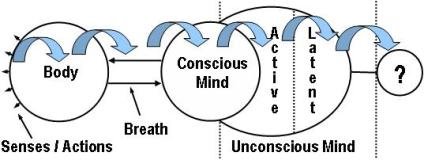
Yoga or "Union" is attained by first training, balancing, and purifying each of the aspects of our being individually, and then systematically receding attention inward through those levels, expanding so as to experience the state of Union, Yoga, Samadhi, or Turiya.
Sunday, April 29, 2007
Saturday, April 21, 2007
Practice Means to Awaken the Conscience
http://www.swamij.com/swami-rama-conscience.htm
From Samadhi: The Highest State of Wisdom
Volume One of Yoga the Sacred Science
(Lectures on the Yoga Sutras)
By Swami Rama
ISBN 8188157015
Reprinted with permission of the Publisher
Copyright Himalayan Institute Hospital Trust
http://hihtindia.org/
Swami Rama Foundation
http://www.swamiramafoundation.us/
PRACTICE MEANS TO AWAKEN THE CONSCIENCE
Swami Rama
You will have to practice for a long time. "Abhyasa-vairagyabhyam tan nirodhah." Practice means repetition of the same thing again and again and again to form a strong habit. Habits are motivation in life. If you do not have determination to attain that which should be attained, if you are not constantly aware of the Reality, how can you practice? You will feel lazy and you will not be able to sit in meditation.
There is one alarm in your system, something coming from within that guides all the time. There is one teacher within that you call your conscience. Whenever you want to do something that should not be done, immediately from inside something says, "Don't do that." It silently says "no." It is not a part of mind. Rather it is your conscience that is telling your mind, whispering to your mind. You have been avoiding that. Habit patterns are so strong that the voice of silence, the voice of the conscience, is not heard. You do not need anyone from outside to tell you what not to do. You know that you should not lie; yet you lie. Once mind listens to these secret whispers, then you are introduced to the real teacher within, your own conscience. All teachings are meant for that day when you start listening to your conscience. It does not mean that you should not listen to the external teacher who is teaching you. Your teacher is trying to make you aware that there is something within you, a teacher within, who is a great friend. No matter who you are, your conscience is always there. If you learn to listen to the voice of the conscience, you can transform your whole personality. That conscience knows everything. No book can teach you; no teacher can teach you. Conscience knows and knows that it knows. Even when you go to a teacher to ask something, you draw your own conclusions and follow your conscience.
But you do not always listen to the teachings of your conscience. In fact, you are constantly killing your conscience. According to the great books of wisdom, the greatest sin of all is to kill your conscience. After some time your conscience stops talking to you because you do not listen to it. You have ignored your conscience so much that it has become silent. It continues to witness your actions but does not say anything. Learn to listen to your conscience. Most of the time you are confused by your mind. Sometimes your mind plays tricks on you and pretends to be your conscience. Mind says, "I can steal some of his money. Nobody is watching me. Why does he need to have millions of dollars? If I steal only one hundred thousand dollars, so what?"
Mind is different from conscience. Your conscience always wants to help you to improve yourself and unfold your inner being. Mind always tries to persuade you not to practice. You know that it is not good for you to avoid your practice, and yet the mind says, "Come on. Postpone it until tomorrow." Postponement is the nature of the mind. Some students do their practice for some time and then they leave it. After some time, they start doing it again. Then they say, "Okay. Let us vacation for some time, honey. Let us not do any practice." Again they start practicing. I call those who postpone enlightenment indefinitely fourth-class students.
Mind always leads you toward your habits, your senses, and sense objects. Perhaps you like to eat fish, but the doctor has said not to take it. The doctor's advice has been heard by your conscience. Your mind does not want to hear it and does not care for doctors. "There are many doctors. Why should I listen to them? Let me have some fish today. Nothing is going to happen to me." Your conscience speaks to you all the time. Conscience is like a mirror that shows you your face exactly as it is. When you look at yourself in the mirror, the mirror does not create anything for you. It is like a thermometer that registers heat and cold. It tells you who you are, what you are, and what you should be. Whenever you want to do something, your conscience says, "Do not do this. It is not good. But your mind says, No. Let me do it."
Conscience cannot be false. It never misguides from the very beginning. Even a bad man who is considered to be the worst person in society is not misguided by his conscience. But you fail to listen to your conscience, and ignore your conscience because of bad habits. When your conscience becomes dim, your reason does not function properly and it misguides you. When reason misguides, the mind cannot function and becomes crazy. All your actions and speech are disoriented and you cannot function properly. Perhaps you are doing something and suddenly a distressing thought intrudes. You are temporarily distracted and then you come back. Then, another thought comes and you go another way. You misuse the time and opportunity you have of being a human being. You have all the potentials and all the means but you misuse them. I always ask my students to listen to their conscience when they feel weak in the beginning. The first few days they start to condemn themselves. I say, "This is not the way. There is a wonderful part of you; there is something beautiful in you; there is something very special in you. Why do you not try to see that thing?" Practice means to awaken the conscience, to allow the conscience to speak to you. When your conscience awakens it says, "Look, do not repeat that again and again and again." By repetition you have formed a strong habit. Your conscience and that habit fight constantly. Your habit wins and conscience loses. After some time, conscience stops talking to you. Conscience tells you things all the time and conscience knows, but you do not know your conscience. The voice of your mind is very loud. The voice of the conscience comes from silence. The first step of enlightenment is to follow the conscience and not the mind. At the highest level of consciousness, conscience becomes brilliant.
Anybody who has started listening to the conscience is very close to the Reality. Your conscience is within you. It is not an external friend. All your external friends amuse you. A friend within is real company. You say, "Two's company and three's a crowd." When you and your conscience are there, there are two and they are real company. When the mind, the third, comes, then it becomes a crowd.
When you start practicing you will stumble many times. I have stumbled many times, even despite having a great force behind me—my master, several other sages, and the grace of God. I had a fire within so that no matter how many times I stumbled I would get up again. I did not give up. You give up too soon. You close your eyes and if you do not see anything in meditation, you say, "My method is not good. My mantra is not good." You go on collecting mantras. You do not do meditation but you have a long collection of mantras. You have wasted so much money, and you have not done any real meditation. In abhyasa and meditation, on this path of enlightenment, you have to be very patient and strong and persistent. When a child stumbles, she gets up again because she wants to walk. It is her right to walk. It is your right to walk on the path and finally reach the goal. Do not postpone it for the next lifetime. Do it here and now, in this lifetime. You do not attain anything overnight; you will stumble many times like a child stumbles when she starts learning to walk. When you practice you will experience, and when you experience you will find that conscience is strengthened and guides you again and again.
Out of curiosity you always want to learn something new. When you learn something that you did not know you say, "This is a wonderful thing that I have learned." You do not want to practice what you already know. The truth is you will not acquire any knowledge in your life that you have not already acquired in your childhood. You already have the basic principles, the guidelines, and the foundation of your knowledge, but you do not practice. To practice it is not necessary to create a rigid discipline. You should just observe and understand how to use the knowledge that you have.
Gradually you can practice. Technique alone does not help. The basic principles needed are sincerity, faithfulness, truthfulness, and punctuality. Even if you know the technique of throwing something at the target, if you do not practice, it will hit somewhere else. Practice is necessary and practice makes perfect. Slowly increase your limit. Do not force yourself to sit for two hours one day, and then do no practice at all for a week. That should not be the way. It is said that a first-class student can attain this state of mind in three months' time, while conducting all his duties, a second-class student in six months, and a third-class student in three years. A fourth-class student can never attain. If you regularly practice and watch your practice and the condition of your mind, you can do it. The question is how much importance you give to your practice. How much anxiety do you have for your practice or for other things? What is important in your life? Do you really want to transform your personality and improve yourself, or do you only want to improve your conditions? If you do not improve yourself, your conditions and your environment will never be improved. It is better to improve yourself so that your conditions and environment do not become malignant to you. To improve your conditions, first learn to understand your essential nature by understanding the various levels of your being and by developing control over mind and its modifications.
There are various paths to the same mountaintop, but there is only one realization. There are various ways and methods to attain that. The path of action or the path of the world is as perfect as the path of renunciation. In the path of action you learn not to be attached and perform your duties. In the path of renunciation you learn to renounce all that you think is yours and to devote all your time and energy toward Self-realization with a one-pointed mind. It is a very difficult path. It is rare to be a renunciate. Only a fortunate few can truly walk on the razor's edge of the path of renunciation. It is a very sharp and very narrow path. It is easier and more common to be in the world, to live in the world, and yet remain above. There is no difference at all. Do not condemn yourself because you are in the world, or think that you cannot do anything. Learn to discipline yourself; learn to organize yourself; learn to understand your resources; learn to know your inner potentials; and learn to make a schedule for life. "This is my aim and I have to attain this. All my resources should be applied for attaining the aim of life."
The way of adjustment leads you to contentment. The way of adjustment is the way of the world—the way of action, the way of karma. You learn how to function in the external world. You understand that you are a citizen of two worlds—the world within yourself and the world outside, and you learn to create a bridge between these two worlds. You have not to be lost in the world, yet you have to unfold yourself to that extent where you can realize your real Self. You no longer identify with the objects of the world or with your mind. You learn to understand life as it is with all its currents and cross currents. You understand how to live in the external world and how to compose yourself so that you remain with your center all the time.
Most people follow the path of action. They live in the world, which is full of charms, temptations, and attractions, and they are constantly blasted by the opinions of others. Someone says you are good and someone else says you are bad. There are two extremes. To constantly be tossed by the suggestions of the world so that you spend all your time executing the opinions of others is dangerous. Likewise, you can isolate yourself and say, "Now I don't want to listen to the world because my whole life I have listened to the world. I am not going to listen anymore." This might lead toward egocentricity or cripple your process of growth. You have to evaluate the opinions of all if you live in the world. Are you being selfish when you are not listening to others? Is the other person selfish? If he is not selfish, listen to him. If someone is selfless and loves you and says, "These days you seem to be isolating yourself," listen to that person. If you say you don't want to listen to anybody, it is not possible. How can you live in this world? You can do it not through the help of samnyasa, but with the help of vairagya.
http://www.swamij.com
From Samadhi: The Highest State of Wisdom
Volume One of Yoga the Sacred Science
(Lectures on the Yoga Sutras)
By Swami Rama
ISBN 8188157015
Reprinted with permission of the Publisher
Copyright Himalayan Institute Hospital Trust
http://hihtindia.org/
Swami Rama Foundation
http://www.swamiramafoundation.us/
PRACTICE MEANS TO AWAKEN THE CONSCIENCE
Swami Rama
You will have to practice for a long time. "Abhyasa-vairagyabhyam tan nirodhah." Practice means repetition of the same thing again and again and again to form a strong habit. Habits are motivation in life. If you do not have determination to attain that which should be attained, if you are not constantly aware of the Reality, how can you practice? You will feel lazy and you will not be able to sit in meditation.
There is one alarm in your system, something coming from within that guides all the time. There is one teacher within that you call your conscience. Whenever you want to do something that should not be done, immediately from inside something says, "Don't do that." It silently says "no." It is not a part of mind. Rather it is your conscience that is telling your mind, whispering to your mind. You have been avoiding that. Habit patterns are so strong that the voice of silence, the voice of the conscience, is not heard. You do not need anyone from outside to tell you what not to do. You know that you should not lie; yet you lie. Once mind listens to these secret whispers, then you are introduced to the real teacher within, your own conscience. All teachings are meant for that day when you start listening to your conscience. It does not mean that you should not listen to the external teacher who is teaching you. Your teacher is trying to make you aware that there is something within you, a teacher within, who is a great friend. No matter who you are, your conscience is always there. If you learn to listen to the voice of the conscience, you can transform your whole personality. That conscience knows everything. No book can teach you; no teacher can teach you. Conscience knows and knows that it knows. Even when you go to a teacher to ask something, you draw your own conclusions and follow your conscience.
But you do not always listen to the teachings of your conscience. In fact, you are constantly killing your conscience. According to the great books of wisdom, the greatest sin of all is to kill your conscience. After some time your conscience stops talking to you because you do not listen to it. You have ignored your conscience so much that it has become silent. It continues to witness your actions but does not say anything. Learn to listen to your conscience. Most of the time you are confused by your mind. Sometimes your mind plays tricks on you and pretends to be your conscience. Mind says, "I can steal some of his money. Nobody is watching me. Why does he need to have millions of dollars? If I steal only one hundred thousand dollars, so what?"
Mind is different from conscience. Your conscience always wants to help you to improve yourself and unfold your inner being. Mind always tries to persuade you not to practice. You know that it is not good for you to avoid your practice, and yet the mind says, "Come on. Postpone it until tomorrow." Postponement is the nature of the mind. Some students do their practice for some time and then they leave it. After some time, they start doing it again. Then they say, "Okay. Let us vacation for some time, honey. Let us not do any practice." Again they start practicing. I call those who postpone enlightenment indefinitely fourth-class students.
Mind always leads you toward your habits, your senses, and sense objects. Perhaps you like to eat fish, but the doctor has said not to take it. The doctor's advice has been heard by your conscience. Your mind does not want to hear it and does not care for doctors. "There are many doctors. Why should I listen to them? Let me have some fish today. Nothing is going to happen to me." Your conscience speaks to you all the time. Conscience is like a mirror that shows you your face exactly as it is. When you look at yourself in the mirror, the mirror does not create anything for you. It is like a thermometer that registers heat and cold. It tells you who you are, what you are, and what you should be. Whenever you want to do something, your conscience says, "Do not do this. It is not good. But your mind says, No. Let me do it."
Conscience cannot be false. It never misguides from the very beginning. Even a bad man who is considered to be the worst person in society is not misguided by his conscience. But you fail to listen to your conscience, and ignore your conscience because of bad habits. When your conscience becomes dim, your reason does not function properly and it misguides you. When reason misguides, the mind cannot function and becomes crazy. All your actions and speech are disoriented and you cannot function properly. Perhaps you are doing something and suddenly a distressing thought intrudes. You are temporarily distracted and then you come back. Then, another thought comes and you go another way. You misuse the time and opportunity you have of being a human being. You have all the potentials and all the means but you misuse them. I always ask my students to listen to their conscience when they feel weak in the beginning. The first few days they start to condemn themselves. I say, "This is not the way. There is a wonderful part of you; there is something beautiful in you; there is something very special in you. Why do you not try to see that thing?" Practice means to awaken the conscience, to allow the conscience to speak to you. When your conscience awakens it says, "Look, do not repeat that again and again and again." By repetition you have formed a strong habit. Your conscience and that habit fight constantly. Your habit wins and conscience loses. After some time, conscience stops talking to you. Conscience tells you things all the time and conscience knows, but you do not know your conscience. The voice of your mind is very loud. The voice of the conscience comes from silence. The first step of enlightenment is to follow the conscience and not the mind. At the highest level of consciousness, conscience becomes brilliant.
Anybody who has started listening to the conscience is very close to the Reality. Your conscience is within you. It is not an external friend. All your external friends amuse you. A friend within is real company. You say, "Two's company and three's a crowd." When you and your conscience are there, there are two and they are real company. When the mind, the third, comes, then it becomes a crowd.
When you start practicing you will stumble many times. I have stumbled many times, even despite having a great force behind me—my master, several other sages, and the grace of God. I had a fire within so that no matter how many times I stumbled I would get up again. I did not give up. You give up too soon. You close your eyes and if you do not see anything in meditation, you say, "My method is not good. My mantra is not good." You go on collecting mantras. You do not do meditation but you have a long collection of mantras. You have wasted so much money, and you have not done any real meditation. In abhyasa and meditation, on this path of enlightenment, you have to be very patient and strong and persistent. When a child stumbles, she gets up again because she wants to walk. It is her right to walk. It is your right to walk on the path and finally reach the goal. Do not postpone it for the next lifetime. Do it here and now, in this lifetime. You do not attain anything overnight; you will stumble many times like a child stumbles when she starts learning to walk. When you practice you will experience, and when you experience you will find that conscience is strengthened and guides you again and again.
Out of curiosity you always want to learn something new. When you learn something that you did not know you say, "This is a wonderful thing that I have learned." You do not want to practice what you already know. The truth is you will not acquire any knowledge in your life that you have not already acquired in your childhood. You already have the basic principles, the guidelines, and the foundation of your knowledge, but you do not practice. To practice it is not necessary to create a rigid discipline. You should just observe and understand how to use the knowledge that you have.
Gradually you can practice. Technique alone does not help. The basic principles needed are sincerity, faithfulness, truthfulness, and punctuality. Even if you know the technique of throwing something at the target, if you do not practice, it will hit somewhere else. Practice is necessary and practice makes perfect. Slowly increase your limit. Do not force yourself to sit for two hours one day, and then do no practice at all for a week. That should not be the way. It is said that a first-class student can attain this state of mind in three months' time, while conducting all his duties, a second-class student in six months, and a third-class student in three years. A fourth-class student can never attain. If you regularly practice and watch your practice and the condition of your mind, you can do it. The question is how much importance you give to your practice. How much anxiety do you have for your practice or for other things? What is important in your life? Do you really want to transform your personality and improve yourself, or do you only want to improve your conditions? If you do not improve yourself, your conditions and your environment will never be improved. It is better to improve yourself so that your conditions and environment do not become malignant to you. To improve your conditions, first learn to understand your essential nature by understanding the various levels of your being and by developing control over mind and its modifications.
There are various paths to the same mountaintop, but there is only one realization. There are various ways and methods to attain that. The path of action or the path of the world is as perfect as the path of renunciation. In the path of action you learn not to be attached and perform your duties. In the path of renunciation you learn to renounce all that you think is yours and to devote all your time and energy toward Self-realization with a one-pointed mind. It is a very difficult path. It is rare to be a renunciate. Only a fortunate few can truly walk on the razor's edge of the path of renunciation. It is a very sharp and very narrow path. It is easier and more common to be in the world, to live in the world, and yet remain above. There is no difference at all. Do not condemn yourself because you are in the world, or think that you cannot do anything. Learn to discipline yourself; learn to organize yourself; learn to understand your resources; learn to know your inner potentials; and learn to make a schedule for life. "This is my aim and I have to attain this. All my resources should be applied for attaining the aim of life."
The way of adjustment leads you to contentment. The way of adjustment is the way of the world—the way of action, the way of karma. You learn how to function in the external world. You understand that you are a citizen of two worlds—the world within yourself and the world outside, and you learn to create a bridge between these two worlds. You have not to be lost in the world, yet you have to unfold yourself to that extent where you can realize your real Self. You no longer identify with the objects of the world or with your mind. You learn to understand life as it is with all its currents and cross currents. You understand how to live in the external world and how to compose yourself so that you remain with your center all the time.
Most people follow the path of action. They live in the world, which is full of charms, temptations, and attractions, and they are constantly blasted by the opinions of others. Someone says you are good and someone else says you are bad. There are two extremes. To constantly be tossed by the suggestions of the world so that you spend all your time executing the opinions of others is dangerous. Likewise, you can isolate yourself and say, "Now I don't want to listen to the world because my whole life I have listened to the world. I am not going to listen anymore." This might lead toward egocentricity or cripple your process of growth. You have to evaluate the opinions of all if you live in the world. Are you being selfish when you are not listening to others? Is the other person selfish? If he is not selfish, listen to him. If someone is selfless and loves you and says, "These days you seem to be isolating yourself," listen to that person. If you say you don't want to listen to anybody, it is not possible. How can you live in this world? You can do it not through the help of samnyasa, but with the help of vairagya.
http://www.swamij.com


Sunday, March 25, 2007
Theism, Atheism, Yoga and Fear
From:
http://www.swamij.com/theism-atheism-yoga-fear.htm
THEISM, ATHEISM, YOGA AND FEAR
Swami Jnaneshvara Bharati
Fear is defined as a feeling of agitation and anxiety caused by the presence or imminence of danger. Though there may be many sources and effects of fear, there is a particular fear related specifically to practitioners of Yoga meditation, as well as other meditative and contemplative practices or traditions. Many sincere seekers of direct experience of subtler realities seem to have a pervasive fear stemming from the negative influences of two polar opposites: the Theists and Religionists, and the Atheists and Secularists.
In America, some Theists or Religionists view Yoga (as well as Mysticism and Gnosis) as being in opposition to their individual form of Theism, and hence, see it as in alignment with Atheism. Some Secular Atheists view the Yoga practices of meditation and contemplation as being part of Theism or Religion. At the same time, however, practitioners of authentic, traditional Yoga usually view both Theism and Atheism as separate from the direct experience sought through these practices.

The often imperceptible fear of the Theists, Religionists, Atheists, and Secularists can be a major obstacle in sadhana or spiritual practices by virtue of the fact that the sadhaka (practitioner) is "going against" the subtle pressures of the human environment. The effect of this fear can be an unconscious reticence to pursue the deeper teachings, or to explore and surrender into the subtler processes such as with advanced meditation or contemplation. Or, the fear may be strong enough to completely stop you on your inner journey of enlightenment, even though it may remain undetected by the conscious mind.
Now, it is important to note that these observations are not intended to make a sweeping generalization about all Theists or all Atheists, most of whom are likely very genuine and well-intentioned people. While there may be some who are individually quite aggressive and destructive in their belief based actions, most are probably just living day-to-day lives, only indirectly and unintentionally causing harm. In reflecting on the influences of other people, it is also important to remember the principle in Yoga of ahimhsa, non-harming, and the value of cultivating love for all, as we all arose from the same one source.
Some Theists or Religionists have a world view that theirs is the only valid way of living, that they are right and everybody else is wrong. If you do not see reality their way, then you are a sinner and are going to burn in hell. The fear being talked about here is not just the fear, for example, of what "God" may do to you for your failing to follow the rules of the religion (though that fear may have also been programmed into you at a deep level). Rather, it is a subtle, often unnoticed, ever present fear of the religious institutions and their human representatives and followers themselves who want you to follow them. It is a fear that creeps not only into your worldly activities with other people, but also into the recesses of your unconscious mind, where it can become a block to your spiritual life.
As if that is not enough, there is a growing presence of Atheists or Secularists who decry all spiritual practices as being irrational and a waste of time. Some of these people are completely convinced that all nature of consciousness emerges solely from matter. If you are not a pure, one hundred percent materialist, you are perceived to be an ignorant Religionist of the most extreme fundamentalist type. The fear is not based on the atheistic possibility of there not being an afterlife, that you will finally, irreversibly no longer exist in any form. Rather, it is a fear of the people themselves, resulting from their rejection of both you and your views, along with an argument that you should disbelieve any metaphysical experiences you may have had, and abandon your seeking of anything higher or deeper.
If either of these types of people, Theist or Atheist, are present in your family, social and career worlds, the unspoken (or spoken) pressure to conform, follow, or convert to their views can be a tremendous threat to your sense of well being, both in terms of emotional response and the realities of functioning in a world of such people. This fear can have a devastating effect on ones feelings of safety in family, community, and professional life, and, in turn, on spiritual life. It can cause hesitancy, timidness, reluctance, mistrust, self-doubt, and other such emotions and reactions, which are often projections of an underlying fear. These, in turn, are antagonists to the tranquility or peace of mind consistent with meditation and other spiritual practices.

In America, the fifty states are spoken of as either red states or blue states, based on political party dominance. The two colors also represent religious polarities of conservative or liberal. Imagine for a moment that there were a third category, which we can call violet states, which would be those where the Yogis and Mystics are in the majority. How many violet states are there? None. The balance of blue states and red states may shift slightly from time to time, but there remain no violet states. If you are red oriented you can easily visit or live in a red environment. If you are blue oriented you can easily visit or live in a blue environment. However, if you are violet oriented there is no state in the U.S. where you can go where you are anything other than a minority. As is often the case with minorities, the stage is set for fear.
So, if you think of yourself as a Yogi, Mystic, or Gnostic seeker, you are extrinsically and subliminally pressured from two directions. One is the Theistic Religionists who say you are evil or damned Atheists, and the other is the Atheistic Secularists who say you are misguided or confused Religionists. You may intuit the all-pervading Reality rather than only some one, single overseer of the world, contrary to the Religious Theist. You may intuit that matter manifests from consciousness, rather than vice versa as seen by the Secular Atheist. In either case, you may find yourself feeling alone, confused and suffering deeply, or at best, feeling yourself to be in a miniscule minority.
In response to this unnoticed fear, you may find yourself speaking in hushed tones when talking with others about subjects like meditation. If a conservative Religious Theist walks in the room, you may lower your voice or change the subject of conversation. You may look around to see who is watching or listening before starting a conversation about the inner contemplative journey. Similarly, you may find yourself suddenly become either very quiet or verbally evasive in the presence of a self-declared Secular Atheist. You may have learned over many years that it is safer to just remain silent, to keep your experiences and perspectives to yourself.
The fear we are talking about here is not a clinical paranoia, but a low level, pervasive fear that may otherwise be having little effect on your daily life, as might be the case with a medically diagnosable paranoia. However, you may find yourself longing for a "community" of "like minded" people, while often feeling alone and not having such a close network of friends and fellow seekers. You may read books, but never have anybody to talk with about them, or with whom you can share your insights or ask your questions. You may meditate or do other practices, but still feel a vague sense of incompleteness that you do not understand.
Theistic Religionists can be quick to label Yogis and other Mystic seekers and organizations as cult followers or cult organizations. They describe the methods of cults as including being emotionally and financially exploitive, psychologically manipulative, demanding of unquestioning dedication or devotion, requiring suspension of critical thinking, and other such means of control. Ironically, it is these very kinds of practices that the Yogi or Mystic may see in the Theists and their organizations. Not knowing quite how to deal with this in work or social settings, the Yogi or Mystic may end up with an internalized fear which may not be recognized as having an unconscious influence over one's own spiritual practices and life.
Does any of this sound familiar to you? If so, you may be carrying around this kind of inner baggage of fear and having it negatively impact your spiritual practices and life. It often manifests as feeling you "do not have time" to meditate or do other practices, as if some invisible force is blocking the path in front of you. It can manifest as feeling you are "not ready" to go ahead on the journey. It can feel like you are "not worthy" to have the joy of direct experience of your own true nature. It can leave you "deciding" to follow the inner journey later in life, maybe after you have a different circle of friends, after you have moved to a different city, after your children are grown, after your relationship with your spouse has changed, or after you retire from your job.
No teacher, no method, no class can deal effectively with this, without seeing clearly the nature of this pervasive fear-filled obstacle, and without having a resolute commitment to see it, explore it, accept it, and not let it prevent you from doing your meditations, contemplations, or other spiritual practices. The suggestion of Patanjali in the Yoga Sutras that these obstacles be dealt with by one-pointed training of mind may lead to feeling even more hopeless because of feeling you "cannot do it," although this ability to stay focused is ultimately seen to be extremely important and useful.
The Theists or Religionists have found or created a very broad range of communities of peers with whom they can relate and provide support for one another. So too, the Atheists and Secularists have increasingly found or built communities for supportive relationships. Surely, some practitioners of Yoga and Mysticism have found or have formed small, supportive communities. Of those, some have encountered and dealt with the fear being talked about here. However, there are many, possibly millions of sincere seekers with lesser experience and exposure who have neither discovered and dealt with the fear, nor found any supportive community where they can openly explore and transcend this very subtle, powerful obstacle. They are quietly suffering alone in an unseen fear of both the Theists and Religionists, and the Atheists and Secularists, who are by far in the majority amongst their neighbors, coworkers and family members.
If you are a sincere seeker of direct experience, it is imperative to see the nature of this fear so that you can develop the will power, the sankalpa shakti, the determination to move forward, right through the middle of these obstacles, regardless of the opinions and actions of your fellow humans, whether Theists or Atheists. This is done by cultivating an active, passionate conviction to seek that for which your heart longs. With this awareness and commitment, and an attitude of loving perseverance, the fear is ultimately seen as a phantom and gradually dissolves into just one more past habit that no longer binds, or blocks the finer realization being sought.
http://www.swamij.com/theism-atheism-yoga-fear.htm
THEISM, ATHEISM, YOGA AND FEAR
Swami Jnaneshvara Bharati
Fear is defined as a feeling of agitation and anxiety caused by the presence or imminence of danger. Though there may be many sources and effects of fear, there is a particular fear related specifically to practitioners of Yoga meditation, as well as other meditative and contemplative practices or traditions. Many sincere seekers of direct experience of subtler realities seem to have a pervasive fear stemming from the negative influences of two polar opposites: the Theists and Religionists, and the Atheists and Secularists.
In America, some Theists or Religionists view Yoga (as well as Mysticism and Gnosis) as being in opposition to their individual form of Theism, and hence, see it as in alignment with Atheism. Some Secular Atheists view the Yoga practices of meditation and contemplation as being part of Theism or Religion. At the same time, however, practitioners of authentic, traditional Yoga usually view both Theism and Atheism as separate from the direct experience sought through these practices.
The often imperceptible fear of the Theists, Religionists, Atheists, and Secularists can be a major obstacle in sadhana or spiritual practices by virtue of the fact that the sadhaka (practitioner) is "going against" the subtle pressures of the human environment. The effect of this fear can be an unconscious reticence to pursue the deeper teachings, or to explore and surrender into the subtler processes such as with advanced meditation or contemplation. Or, the fear may be strong enough to completely stop you on your inner journey of enlightenment, even though it may remain undetected by the conscious mind.
Now, it is important to note that these observations are not intended to make a sweeping generalization about all Theists or all Atheists, most of whom are likely very genuine and well-intentioned people. While there may be some who are individually quite aggressive and destructive in their belief based actions, most are probably just living day-to-day lives, only indirectly and unintentionally causing harm. In reflecting on the influences of other people, it is also important to remember the principle in Yoga of ahimhsa, non-harming, and the value of cultivating love for all, as we all arose from the same one source.
Some Theists or Religionists have a world view that theirs is the only valid way of living, that they are right and everybody else is wrong. If you do not see reality their way, then you are a sinner and are going to burn in hell. The fear being talked about here is not just the fear, for example, of what "God" may do to you for your failing to follow the rules of the religion (though that fear may have also been programmed into you at a deep level). Rather, it is a subtle, often unnoticed, ever present fear of the religious institutions and their human representatives and followers themselves who want you to follow them. It is a fear that creeps not only into your worldly activities with other people, but also into the recesses of your unconscious mind, where it can become a block to your spiritual life.
As if that is not enough, there is a growing presence of Atheists or Secularists who decry all spiritual practices as being irrational and a waste of time. Some of these people are completely convinced that all nature of consciousness emerges solely from matter. If you are not a pure, one hundred percent materialist, you are perceived to be an ignorant Religionist of the most extreme fundamentalist type. The fear is not based on the atheistic possibility of there not being an afterlife, that you will finally, irreversibly no longer exist in any form. Rather, it is a fear of the people themselves, resulting from their rejection of both you and your views, along with an argument that you should disbelieve any metaphysical experiences you may have had, and abandon your seeking of anything higher or deeper.
If either of these types of people, Theist or Atheist, are present in your family, social and career worlds, the unspoken (or spoken) pressure to conform, follow, or convert to their views can be a tremendous threat to your sense of well being, both in terms of emotional response and the realities of functioning in a world of such people. This fear can have a devastating effect on ones feelings of safety in family, community, and professional life, and, in turn, on spiritual life. It can cause hesitancy, timidness, reluctance, mistrust, self-doubt, and other such emotions and reactions, which are often projections of an underlying fear. These, in turn, are antagonists to the tranquility or peace of mind consistent with meditation and other spiritual practices.
In America, the fifty states are spoken of as either red states or blue states, based on political party dominance. The two colors also represent religious polarities of conservative or liberal. Imagine for a moment that there were a third category, which we can call violet states, which would be those where the Yogis and Mystics are in the majority. How many violet states are there? None. The balance of blue states and red states may shift slightly from time to time, but there remain no violet states. If you are red oriented you can easily visit or live in a red environment. If you are blue oriented you can easily visit or live in a blue environment. However, if you are violet oriented there is no state in the U.S. where you can go where you are anything other than a minority. As is often the case with minorities, the stage is set for fear.
So, if you think of yourself as a Yogi, Mystic, or Gnostic seeker, you are extrinsically and subliminally pressured from two directions. One is the Theistic Religionists who say you are evil or damned Atheists, and the other is the Atheistic Secularists who say you are misguided or confused Religionists. You may intuit the all-pervading Reality rather than only some one, single overseer of the world, contrary to the Religious Theist. You may intuit that matter manifests from consciousness, rather than vice versa as seen by the Secular Atheist. In either case, you may find yourself feeling alone, confused and suffering deeply, or at best, feeling yourself to be in a miniscule minority.
In response to this unnoticed fear, you may find yourself speaking in hushed tones when talking with others about subjects like meditation. If a conservative Religious Theist walks in the room, you may lower your voice or change the subject of conversation. You may look around to see who is watching or listening before starting a conversation about the inner contemplative journey. Similarly, you may find yourself suddenly become either very quiet or verbally evasive in the presence of a self-declared Secular Atheist. You may have learned over many years that it is safer to just remain silent, to keep your experiences and perspectives to yourself.
The fear we are talking about here is not a clinical paranoia, but a low level, pervasive fear that may otherwise be having little effect on your daily life, as might be the case with a medically diagnosable paranoia. However, you may find yourself longing for a "community" of "like minded" people, while often feeling alone and not having such a close network of friends and fellow seekers. You may read books, but never have anybody to talk with about them, or with whom you can share your insights or ask your questions. You may meditate or do other practices, but still feel a vague sense of incompleteness that you do not understand.
Theistic Religionists can be quick to label Yogis and other Mystic seekers and organizations as cult followers or cult organizations. They describe the methods of cults as including being emotionally and financially exploitive, psychologically manipulative, demanding of unquestioning dedication or devotion, requiring suspension of critical thinking, and other such means of control. Ironically, it is these very kinds of practices that the Yogi or Mystic may see in the Theists and their organizations. Not knowing quite how to deal with this in work or social settings, the Yogi or Mystic may end up with an internalized fear which may not be recognized as having an unconscious influence over one's own spiritual practices and life.
Does any of this sound familiar to you? If so, you may be carrying around this kind of inner baggage of fear and having it negatively impact your spiritual practices and life. It often manifests as feeling you "do not have time" to meditate or do other practices, as if some invisible force is blocking the path in front of you. It can manifest as feeling you are "not ready" to go ahead on the journey. It can feel like you are "not worthy" to have the joy of direct experience of your own true nature. It can leave you "deciding" to follow the inner journey later in life, maybe after you have a different circle of friends, after you have moved to a different city, after your children are grown, after your relationship with your spouse has changed, or after you retire from your job.
No teacher, no method, no class can deal effectively with this, without seeing clearly the nature of this pervasive fear-filled obstacle, and without having a resolute commitment to see it, explore it, accept it, and not let it prevent you from doing your meditations, contemplations, or other spiritual practices. The suggestion of Patanjali in the Yoga Sutras that these obstacles be dealt with by one-pointed training of mind may lead to feeling even more hopeless because of feeling you "cannot do it," although this ability to stay focused is ultimately seen to be extremely important and useful.
The Theists or Religionists have found or created a very broad range of communities of peers with whom they can relate and provide support for one another. So too, the Atheists and Secularists have increasingly found or built communities for supportive relationships. Surely, some practitioners of Yoga and Mysticism have found or have formed small, supportive communities. Of those, some have encountered and dealt with the fear being talked about here. However, there are many, possibly millions of sincere seekers with lesser experience and exposure who have neither discovered and dealt with the fear, nor found any supportive community where they can openly explore and transcend this very subtle, powerful obstacle. They are quietly suffering alone in an unseen fear of both the Theists and Religionists, and the Atheists and Secularists, who are by far in the majority amongst their neighbors, coworkers and family members.
If you are a sincere seeker of direct experience, it is imperative to see the nature of this fear so that you can develop the will power, the sankalpa shakti, the determination to move forward, right through the middle of these obstacles, regardless of the opinions and actions of your fellow humans, whether Theists or Atheists. This is done by cultivating an active, passionate conviction to seek that for which your heart longs. With this awareness and commitment, and an attitude of loving perseverance, the fear is ultimately seen as a phantom and gradually dissolves into just one more past habit that no longer binds, or blocks the finer realization being sought.
Thursday, March 15, 2007
Yoga Nidra Meditation CD Recommended for Insomnia
YOGA NIDRA MEDITATION CD RECOMMENDED FOR INSOMNIA
Chicago Tribune writer Julie Deardorff recommends the Yoga Nidra CD of Swami Jnaneshvara (ISBN 0972471901) for dealing with insomnia (point #2 of 3 in her article below).
From Chicago Tribune article:
http://featuresblogs.chicagotribune.com/features_julieshealthclub/2007/03/how_to_cope_wit.html
HOW TO SURVIVE INSOMNIA
By Julie Deardorff
Chicago Tribune
March 7, 2007
Working mothers trying to "do it all" have the most serious episodes of insomnia, while stay-at-home moms are most likely to sleep poorly, according to the National Sleep Foundation's 2007 Sleep in AmericaPoll.
The main culprits are young children, biological changes like pregnancy and menopause, stress and pets.
I had my first extended bout with insomnia during what should have been a triumphant period of motherhood: right when my oldest child started sleeping through the night. Now, with a 3-month old and a toddler, I don't even try to get sleep. And I don't worry when I still haven't fallen asleep by 2 a.m. and I've just calculated that the most sleep I can get is four hours.
Instead, I do damage control the following day.
Here's how.
1. Exercise.
Exercise is one of the first things to go when women have too much in their day, the study showed, but I use it for a short-term jolt, like caffeine.
Normally, I get on the treadmill, do a slow, warm-up mile and then punish myself for about 15 minutes with either speed or hills. The only requirement is that I break a sweat. Then I run easy for a cool-down mile.
Unfortunately, you'll have to try this at your own risk. When I began looking at research on this, it showed that exercise can actually make you feel worse when you're sleep deprived and can be dangerous. Your coordination goes when you're tired and you actually fall off of the treadmill. Also, if your body doesn't have time to repair during sleep, you're more likely to get injured.
Still, it's how I've been able to work full time despite getting up at least two times a night to nurse. After an intense workout, my head clears and I can focus and get through the day.
2. Yoga Nidra
Yoga Nidra means "Yogic Sleep" and it's considered a state of conscious deep sleep. But it's not meditation, which leaves you in the waking state of consciousness, says Swami Jnaneshvara Bharati, who produced the audio CD "Yoga Nidra Meditation CD: Extreme Relaxation of Conscious Deep Sleep."
Instead, during Yoga Nidra, you "leave the waking state, go past the dreaming state and enter into deep sleep, all while remaining fully alert and awake," Bharti says. Reaching this state of awareness is easier said than done, of course. To this day, I haven't been able to stay awake through an entire Yoga Nidra CD, which can last between 20 and 60 minutes.
To do it, lie on your back as if in shavasana or corpse pose, with your eyes closed and your palms facing up. If you've got Bhrarti's verbal CD--there's no music--he'll tell you to focus your awareness on 61 points within the body. For example, he'll tell you to bring your attention to your left hand, your pinky finger, your ring finger, your middle finger, your index finger and your thumb. The entire body is scanned in this way until the heart center is reached.
Some swear the process can replace sleep. Others with insomnia use it to help them relax so they can go to sleep.
3. Caffeine
The old standby works because it blocks a certain receptor in the brain that releases a neurotransmitter called adenosine. Adenosine makes us sleepy and if the release of it is prevented, you won't feel quite as tired.
The trick is to avoid using caffeine every day. Only people who avoid it for a while feel a buzz , according to a University of Bristol study presented to the British Nutrition Foundation Conference.
"We do feel a boost from caffeine in the morning, but that's probably due to a reversal of the withdrawal symptoms," researcher Peter Rogers, a biological psychologist told the BBC. "That alertness you feel is you getting back to normal, rather than to an above normal level."
----------------------------------------------------------
Yoga Nidra Meditation: Extreme Relaxation of Conscious Deep Sleep
ISBN 0972471901
One of the deepest and most popular meditation CDs in the world today.
Yoga Nidra Article at SwamiJ.com
Yoga Nidra CD at Amazon.com
----------------------------------------------------------
Chicago Tribune writer Julie Deardorff recommends the Yoga Nidra CD of Swami Jnaneshvara (ISBN 0972471901) for dealing with insomnia (point #2 of 3 in her article below).
From Chicago Tribune article:
http://featuresblogs.chicagotribune.com/features_julieshealthclub/2007/03/how_to_cope_wit.html
HOW TO SURVIVE INSOMNIA
By Julie Deardorff
Chicago Tribune
March 7, 2007
Working mothers trying to "do it all" have the most serious episodes of insomnia, while stay-at-home moms are most likely to sleep poorly, according to the National Sleep Foundation's 2007 Sleep in AmericaPoll.
The main culprits are young children, biological changes like pregnancy and menopause, stress and pets.
I had my first extended bout with insomnia during what should have been a triumphant period of motherhood: right when my oldest child started sleeping through the night. Now, with a 3-month old and a toddler, I don't even try to get sleep. And I don't worry when I still haven't fallen asleep by 2 a.m. and I've just calculated that the most sleep I can get is four hours.
Instead, I do damage control the following day.
Here's how.
1. Exercise.
Exercise is one of the first things to go when women have too much in their day, the study showed, but I use it for a short-term jolt, like caffeine.
Normally, I get on the treadmill, do a slow, warm-up mile and then punish myself for about 15 minutes with either speed or hills. The only requirement is that I break a sweat. Then I run easy for a cool-down mile.
Unfortunately, you'll have to try this at your own risk. When I began looking at research on this, it showed that exercise can actually make you feel worse when you're sleep deprived and can be dangerous. Your coordination goes when you're tired and you actually fall off of the treadmill. Also, if your body doesn't have time to repair during sleep, you're more likely to get injured.
Still, it's how I've been able to work full time despite getting up at least two times a night to nurse. After an intense workout, my head clears and I can focus and get through the day.
2. Yoga Nidra
Yoga Nidra means "Yogic Sleep" and it's considered a state of conscious deep sleep. But it's not meditation, which leaves you in the waking state of consciousness, says Swami Jnaneshvara Bharati, who produced the audio CD "Yoga Nidra Meditation CD: Extreme Relaxation of Conscious Deep Sleep."
Instead, during Yoga Nidra, you "leave the waking state, go past the dreaming state and enter into deep sleep, all while remaining fully alert and awake," Bharti says. Reaching this state of awareness is easier said than done, of course. To this day, I haven't been able to stay awake through an entire Yoga Nidra CD, which can last between 20 and 60 minutes.
To do it, lie on your back as if in shavasana or corpse pose, with your eyes closed and your palms facing up. If you've got Bhrarti's verbal CD--there's no music--he'll tell you to focus your awareness on 61 points within the body. For example, he'll tell you to bring your attention to your left hand, your pinky finger, your ring finger, your middle finger, your index finger and your thumb. The entire body is scanned in this way until the heart center is reached.
Some swear the process can replace sleep. Others with insomnia use it to help them relax so they can go to sleep.
3. Caffeine
The old standby works because it blocks a certain receptor in the brain that releases a neurotransmitter called adenosine. Adenosine makes us sleepy and if the release of it is prevented, you won't feel quite as tired.
The trick is to avoid using caffeine every day. Only people who avoid it for a while feel a buzz , according to a University of Bristol study presented to the British Nutrition Foundation Conference.
"We do feel a boost from caffeine in the morning, but that's probably due to a reversal of the withdrawal symptoms," researcher Peter Rogers, a biological psychologist told the BBC. "That alertness you feel is you getting back to normal, rather than to an above normal level."
----------------------------------------------------------
Yoga Nidra Meditation: Extreme Relaxation of Conscious Deep Sleep
ISBN 0972471901
One of the deepest and most popular meditation CDs in the world today.
Yoga Nidra Article at SwamiJ.com
Yoga Nidra CD at Amazon.com
----------------------------------------------------------
Wednesday, March 07, 2007
All Yoga practices are to purify and strengthen the mind
ALL PRACTICES ARE TO PURIFY AND STRENGTHEN THE MIND
Swami Rama
All sadhanas, all practices, are meant to purify and strengthen the mind that disturbs your being and prevents you from being aware of the Reality that is within you.
To be spiritual means to be aware of the Reality all the time, to be aware of the Absolute Truth all the time, and to be aware of the Lord within you all the time.
http://swamij.com/
Swami Rama
All sadhanas, all practices, are meant to purify and strengthen the mind that disturbs your being and prevents you from being aware of the Reality that is within you.
To be spiritual means to be aware of the Reality all the time, to be aware of the Absolute Truth all the time, and to be aware of the Lord within you all the time.
http://swamij.com/
Sunday, March 04, 2007
Relationship with Guru in the Path of Yoga
From:
http://www.swamij.com/swami-rama-guru-grace.htm
RELATIONSHIP WITH GURU IN THE PATH OF YOGA
Swami Rama
Guru is not a person, but guru can be represented in a person. One who has developed his or her own spiritual awareness to a very high level can guide others, and is considered to be guru. Only one who is finely attuned to the inner guide can inspire the awakening of the inner guide in another. Guru is not a physical being. If a guru begins thinking this power is her or his own, then they are no longer a guide. The guru is a tradition, a stream of knowledge.
In India guru is a sacred word that is used with reverence and is always associated with the highest wisdom. The guru is unique in a person's life. The relationship between disciple and guru is like no other relationship. It is said that guru is not mother, father, son, or daughter. The guru is not a friend in any conventional sense. It also is sometimes said that the guru is father, mother, son, daughter, and friend all in one; the guru is sun and moon, sky and earth to the disciple.
The truth is that the relationship of guru to disciple is indescribable. The relationship extends to the realm beyond the world, transcends death, and stretches far beyond the limited karmic bonds associated with family and friends. A mother and father help sustain the body of their child, and nurture and guide the child through the formative years of life to adulthood. Guru sustains, nurtures, and guides a soul through lifetimes to ultimate liberation.
The relationship with the guru is based on the purest form of unconditional love. There is complete openness with the guru. The disciple should hold nothing back from the guru. This is why in the tradition, a student goes to the guru and offers a bundle of sticks to burn. The bundle symbolizes that everything the disciple has is offered unconditionally to the guru. Everything is offered to the guru so the guru can do the work of shaping the student spiritually. The disciple comes with full faith and entrusts his whole life to the guru. The guru takes that life and chops it and burns what is not necessary, and then carefully carves what remains into something sacred.
In this chopping and burning, the guru is merciless. The guru's job is not to hold hands with the disciple and wipe away tears, but to cut into pieces the disciple's ego and all that stands between the disciple and freedom. The guru does not allow dependence. If the disciple becomes too dependent on the guru, the guru pushes the disciple away, insisting on independence. It is a remarkable expression of the deepest love.
http://www.swamij.com/
http://www.swamij.com/swami-rama-guru-grace.htm
RELATIONSHIP WITH GURU IN THE PATH OF YOGA
Swami Rama
Guru is not a person, but guru can be represented in a person. One who has developed his or her own spiritual awareness to a very high level can guide others, and is considered to be guru. Only one who is finely attuned to the inner guide can inspire the awakening of the inner guide in another. Guru is not a physical being. If a guru begins thinking this power is her or his own, then they are no longer a guide. The guru is a tradition, a stream of knowledge.
In India guru is a sacred word that is used with reverence and is always associated with the highest wisdom. The guru is unique in a person's life. The relationship between disciple and guru is like no other relationship. It is said that guru is not mother, father, son, or daughter. The guru is not a friend in any conventional sense. It also is sometimes said that the guru is father, mother, son, daughter, and friend all in one; the guru is sun and moon, sky and earth to the disciple.
The truth is that the relationship of guru to disciple is indescribable. The relationship extends to the realm beyond the world, transcends death, and stretches far beyond the limited karmic bonds associated with family and friends. A mother and father help sustain the body of their child, and nurture and guide the child through the formative years of life to adulthood. Guru sustains, nurtures, and guides a soul through lifetimes to ultimate liberation.
The relationship with the guru is based on the purest form of unconditional love. There is complete openness with the guru. The disciple should hold nothing back from the guru. This is why in the tradition, a student goes to the guru and offers a bundle of sticks to burn. The bundle symbolizes that everything the disciple has is offered unconditionally to the guru. Everything is offered to the guru so the guru can do the work of shaping the student spiritually. The disciple comes with full faith and entrusts his whole life to the guru. The guru takes that life and chops it and burns what is not necessary, and then carefully carves what remains into something sacred.
In this chopping and burning, the guru is merciless. The guru's job is not to hold hands with the disciple and wipe away tears, but to cut into pieces the disciple's ego and all that stands between the disciple and freedom. The guru does not allow dependence. If the disciple becomes too dependent on the guru, the guru pushes the disciple away, insisting on independence. It is a remarkable expression of the deepest love.
http://www.swamij.com/
Saturday, March 03, 2007
Yoga Nidra is Not Affirmations or Autosuggestion
YOGA NIDRA IS NOT AFFIRMATIONS OR AUTOSUGGESTION
(Excerpted from the Yoga Nidra article at SwamiJ.com)
Yoga Nidra is not a practice of autosuggestion or verbal affirmations, whether affirming desired personal qualities or worldly objects that are desired. It is also not a process of verbally affirming that you are in Yoga Nidra. If you are still in such a conscious level that you are still making oral affirmations of any kind, then you are definitely not in the subtle state of Yoga Nidra. In such a case, the conscious, Waking state mind has not yet receded into the cause from which it arose.
Yoga Nidra CD on Amazon.com
Yoga Nidra Article on SwamiJ.com
SwamiJ.com Homepage
(Excerpted from the Yoga Nidra article at SwamiJ.com)
Yoga Nidra is not a practice of autosuggestion or verbal affirmations, whether affirming desired personal qualities or worldly objects that are desired. It is also not a process of verbally affirming that you are in Yoga Nidra. If you are still in such a conscious level that you are still making oral affirmations of any kind, then you are definitely not in the subtle state of Yoga Nidra. In such a case, the conscious, Waking state mind has not yet receded into the cause from which it arose.

Yoga Nidra CD on Amazon.com
Yoga Nidra Article on SwamiJ.com
SwamiJ.com Homepage

Subscribe to:
Posts (Atom)


