http://www.swamij.com/ THE MEANING AND PURPOSE OF YOGA
By Bhole Prabhu
Like many arts and sciences that are profound, beautiful, and
powerful, yoga has suffered from the spiritual poverty of the modern
world--it has been trivialized, watered down, or reduced to cliches.
The deep and eternal essence of yoga has been misrepresented and
packaged for personal profit by clever people. At the hands of some,
yoga has been reduced to the status of just another exercise program
available on videotape. In other contexts, yoga has been presented as
a cult religion, aimed at attracting "devotees." Such a haze of
confusion has been created around the clear and pure concept of yoga
that it is now necessary to redefine yoga and clarify its meaning and
purpose.
Yoga defines itself as a science--that is, as a practical, ethodical,
and systematic discipline or set of techniques that have the lofty
goal of helping human beings to become aware of their deepest nature.
The goal of seeking to experience this deepest potential is not part
of a religious process, but an experiential science of self-study.
Religions seek to define what we should believe, while a practical
science such as meditation is based on the concrete experience of
those teachers and yogis who have previously used these techniques to
experience the deepest Self. Yoga does not contradict or interfere
with any religion, and may be practiced by everyone, whether they
regard themselves as agnostics or members of a particular faith.
Throughout history, yogic techniques have been practiced in both the
East and West, so it would be an error to consider yoga an "Eastern
import." In fact, yoga, with its powerful techniques for creating a
sense of inner peace, harmony, and clarity of mind, is absolutely
relevant to the modern world--both East and West. Given the increasing
pace and conflict present in modern life, with all its resulting
stress, one could say that yoga has become an essential tool for
survival, as well as for expanding the creativity and joy of our lives.
THE LIVING TRADITION
Although yoga does not "belong" to the East, it is easiest to trace
its roots there, because cultural change has not obscured the origins
of the science, and an ongoing tradition of yoga has continued to the
present day. No one person "invented" yoga--yoga is a living
tradition, a set of practices that dates back for centuries. These
practices were codified by a scholar and teacher named Patanjali in
The Yoga Sutras, written about the second century B.C.
The most important teaching of yoga has to do with our nature as human
beings. It states that our "true nature" goes far beyond the limits of
the human mind and personality--that instead, our human potential is
infinite and transcends our individual minds and our sense of self.
The very word "yoga" makes reference to this. The root, "yuj" (meaning
"unity" or "yoke"), indicates that the purpose of yoga is to unite
ourselves with our highest nature. This re-integration is accomplished
through the practices of the various yoga disciplines. Until this
re-integration takes place, we identify ourselves with our
limitations--the limitations of the body, mind, and senses. Thus we
feel incomplete and limited, and are subject to feelings of sorrow,
insecurity, fear, and separation, because we have separated ourselves
from the experience of the whole.
In the modern world we have become quite successful in our external
achievements--we have created powerful technologies and a variety of
products, we are obsessed with accumulating power, wealth, property
and objects--and yet we have not been able to create either individual
or social peace, wisdom, or happiness. We have only to look around and
see the destructiveness of our weapons, the emptiness of our pleasures
and entertainments, the misuse of our material and personal resources,
the disparities between rich and poor, and above all, the loneliness
and violence of our modern world. We see that amid all our success in
the external world, we have accomplished little of lasting value.
These problems will not be solved through new technological
developments. Instead, the resolution to these human problems will
come only when we discover within ourselves that for which all of
mankind is searching--inner peace, tranquility, and wisdom. This
attainment is the goal of yoga, for yoga is the practical science
intended to help human beings become aware of their ultimate nature.
AN ASCENT INTO PURITY
The process of yoga is an ascent into the purity of the absolute
perfection that is the essential state of all human beings. This goal
requires the removal of our enveloping personal impurities, the
stilling of our lower feelings and thoughts, and the establishment of
a state of inner balance and harmony. All the methods of yoga are
based on the perfection of our personalities and may help to create a
new world order.
In the beginning of our work, the greatest problem we experience is
our inherent restlessness of mind. Mind, by its very nature, is
outgoing and unsteady. The highest state of meditation, however,
requires a calm, serene, one-pointed mind, free from negative emotions
and the distractions created by cravings, obsessions, and desires. To
reach the subtler levels of consciousness and awareness, we need
willpower, clarity of mind, and the ability to consciously direct the
mind towards our goal. This is possible only when we turn away from
preoccupation with external acquisition and seek to stop all
inharmonious or negative mental processes. To achieve this, we do not
need to give up our homes and society and retire to a monastery.
Instead, we can achieve a state of peace, harmony, and contentment in
our daily meditation, and thus, go on carrying out our life's duties
and activities with the love and devotion that emerges from our
meditative experience.
For those who want to follow the path of yoga towards peace and
evolution, there are a few prerequisites. We need good health, a calm
mind, sincerity, and a burning desire to rise above our human
imperfections. Our health is maintained by a simple and well-
regulated diet, adequate sleep, some physical exercise, and
relaxation. Imbalance or excesses in food, exercise, sleep, or our
personal relationships produce physical and emotional disruptions that
disturb the practice of yoga and meditation.
If the aspects of our daily lives are well balanced, then certainly we
can make progress in yoga in the modern world. Regardless of where we
live or what we do, we can create a life conducive to yoga.
PATHS TO THE SUMMIT
As we indicated earlier, there is much confusion about exactly what
yoga is, especially since there seem to be so many approaches, all
described by the name "yoga." A mountain climber may take a variety of
routes to reach the top of a mountain. From the plain at the base of
the mountain, all these paths seem distinct and different, but from
the mountain summit, the view is always the same! The same is true of
the seeming diversity of the yogic paths. These different paths are
not mutually exclusive or conflicting, but are intended to accommodate
the various inclinations, personalities, and temperaments of
individual students, and yet they all have the same goal. These
various paths of yoga include:
1) Hatha yoga, which deals mostly with body and breathing exercises
that help the student to become aware of his or her internal states.
Hatha yoga exercises help to make the body a healthy and strong
resource for the student.
2) Karma yoga, which means "the yoga of action." This path teaches us
to do our own duties in life skillfully and selflessly, dedicating the
results of our actions to humanity. Practicing this aspect of yoga
helps us to live unselfishly and successfully in the world without
being burdened or distressed.
3) Jnana yoga is the path of knowledge and wisdom. This path involves
intense mental discipline. Knowledge dawns as we learn to discriminate
between the real and the unreal, between the transient and the
everlasting, between the finite and the infinite. This path is meant
for only a fortunate few, who are aware of the higher and subtler
realities of life.
4) Bhakti yoga is the yoga of devotion. This path is the way of love
and devotion. It is the path of self-surrender, of devoting and
dedicating all human resources to attaining the ultimate reality.
5) Kundalini yoga is a highly technical science. The guidance of a
competent teacher is required to learn methods for awakening the
serpent-like vital force that remains dormant and asleep in every
human body.
6) Mantra yoga, which involves meditation and the use of certain
sounds called "mantras," which are traditionally transmitted to the
student, and are used as objects of concentration. Mantras help the
student in self-purification, concentration, and meditation. These
mantras were discovered in deep meditation by highly advanced sages
and teachers.
Finally, there is raja yoga, the "royal path" which is very scientific
and thorough. By following this path methodically, we learn to refine
our desires, emotions, and thoughts, as well as the subtle impressions
and thoughts that lie dormant in the unconscious mind. Raja yoga helps
us to experience the inner reality by using an eight-runged ladder.
The ultimate goal is for the aspirant to attain the eighth rung, samadhi.
THE ROYAL PATH
Raja yoga encompasses teachings from all the different paths. Because
of its variety it can be practiced by people of many backgrounds and
temperaments. It involves all three dimensions of human interaction--
physical, mental, and spiritual. Through this path, we achieve balance
and harmony of all three levels and then attain full realization of
the Self.
Raja yoga is a scientific discipline that does not impose
unquestioning faith, but encourages healthy examination. Certain
practices are prescribed and the benefits derived from them are
described so that this path can be scientifically verified by anyone
who experiments with the methods. Because of this, raja yoga is
ideally suited to the modern world, in which scientific skepticism is
so prominent.
Raja yoga is also called astanga yoga, or "the eight-fold path,"
because its eight steps create an orderly process of self-
transformation beginning on the level of the physical body, and
eventually involving the subtler levels of life. The eight steps are
yama, niyama, asana, pranayama, pratyahara, dharana, dhyana, and samadhi.
EXTERNAL PRACTICES
The first four rungs or steps--yama, niyama, asana, and pranayama,
comprise the path of hatha yoga, which is preparatory to the last four
stages of raja yoga.
Yama and niyama are ten commitments of attitude and behavior. One set
of disciplines (niyama) is meant to improve the human personality and
the other (yama) is meant to guide our relationships and interactions
with other beings in the world. Thus yoga is an education for both
internal and external growth.
The five yamas, or restraints, are nonviolence, truthfulness,
nonstealing, sensual moderation, and non- possessiveness. Their
practice leads to changes in behavior and emotions, in which all
negative emotions are replaced by positive ones. The five niyamas, or
observances, are cleanliness (both external and internal),
contentment, practices which bring about perfection of body and senses
(tapas), study of the scriptures, and surrender to the ultimate
reality. The niyamas lead to the control of our behavior and
eventually are extremely positive factors in developing the personality.
In the beginning we should not be discouraged by the challenge of
these first two steps. For example, even before we have succeeded in
developing the trait of nonviolence completely, we will see increasing
peace in our lives and meditation as a result of attempting to
practice this yama.
Usually, when hatha yoga is taught in the modern world, only asanas
(physical postures) and certain breathing practices are taught. Yama
and niyama often are ignored. Because of this, hatha yoga has become
somewhat superficial, sometimes emphasizing only physical beauty or
egoism about skill and strength in postures. Certainly asanas and
breathing exercises create physical health and harmony, but only when
our minds are free from violent emotions can we achieve a calm,
creative, and tranquil mental state.
Actually, there are two types of asanas--meditative postures and
postures that ensure physical well-being. A stable meditative posture
helps us create a serene breath and calm mind. A good meditative
posture should be comfortable and stable, ensuring that the head,
neck, and trunk are erect and in a straight line. If the body is
uncomfortable, it makes the mind agitated and distracted. The second
kind of postures are practiced to perfect the body, making it limber
and free from disease. These postures stimulate specific muscles and
nerves and have very beneficial effects.
The fourth step of raja yoga is pranayama. Prana is the vital energy
that sustains body and mind. The grossest manifestation of prana is
the breath, so pranayama is also called the "science of breath." These
exercises lead to calming and concentration.
INTERNAL PRACTICES
The four steps of hatha yoga prepare the student for the four internal
practices of raja yoga. These internal practices are pratyahara,
dharana, dhyana, and samadhi.
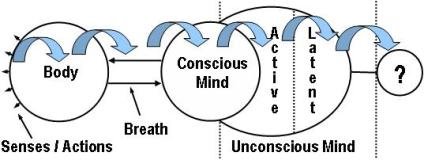
The fifth step of raja yoga is pratyahara or withdrawal and control of
the senses. While we are awake, the mind becomes involved with the
events, experiences, and objects of the external world through the
five senses of sight, hearing, touch, taste, and smell. The mind
constantly gathers sensations from the external world through these
senses and our mind reacts to them. To attain inner calmness, the
student of yoga will want to develop the ability to voluntarily remove
the distractions of the world outside. This is not a physical process
but a voluntary, mental process of letting go of our involvement with
external sensations.
Our sensory impressions distract the mind when we want it to become
aware of serenity within. Thus, it is useful to learn dharana, or
concentration, the sixth step in raja yoga. In concentration, the
scattered power of the mind is coordinated and focused on an object of
concentration through continued voluntary attention. This voluntary
attention uses a conscious effort of the will, and it is developed
through consistent practice. Through concentration, a scattered, weak
mind is focused and made more powerful.
The seventh step in raja yoga is dhyana, or meditation. Meditation is
the result of continued, unbroken concentration. Concentration makes
the mind one-pointed, calm, and serene. Meditation then expands the
one-pointed mind to the superconscious state. Meditation is the
uninterrupted flow of the mind toward one object or concept. When the
mind expands beyond conscious and subconscious levels and assumes this
superconscious flow, then intuitive knowledge dawns. All the methods
of yoga prepare us to eventually reach this stage of meditation and
thus attain peace, perfection, and tranquility.
In our daily lives, meditation can be very helpful in eliminating many
physical and psychological problems. A significant amount of the
disease we experience is actually either directly or indirectly the
result of conflicts, repression, or emotional distress arising in the
conscious or unconscious mind. Meditation helps us to become aware of
these conflicts and to resolve them, establishing tranquility and
peace. In this way, meditation becomes a powerful resource for facing
the challenges of daily life.
If we really consider how we learn in the modern world, we realize
that despite all our emphasis on education, our education is one-
sided and shallow. We may learn to memorize equations and facts, but
we do not really learn to understand and develop our own inner life.
Our minds remain scattered and our emotions persist as negative,
conflicting forces. We are able to use only a small portion of our
mental abilities, because we are preoccupied with confusion, fear, and
inner conflict. Meditation helps us to overcome these limitations; it
helps us to become aware of the subtler and more positive powers
within. In gaining this awareness, we become creative and dynamic.
Abilities such as intuition, which many consider unusual or rare, are
actually within the potential of all human beings who meditate. Such
gifts are available to those who make contact with the deeper aspects
within themselves.
Prolonged and intense meditation leads to the last step of raja yoga--
the state of samadhi, the superconscious state. In this state we
become one with the higher Self and transcend all imperfections and
limitations. The state of samadhi is the fourth state of
consciousness, which transcends the three normal states of waking,
dreaming, and dreamless sleep.
A person who attains samadhi becomes a gift to his or her society. If
humanity is ever to achieve a more evolved civilization, it will be
possible only because of our growth and evolution as human beings. A
person who is established in samadhi lives his or her whole life as a
spontaneous expression of the unhindered flow of supreme
consciousness. This superconscious level is our human essence; it is
universal and transcends all the divisions of culture, creed, gender
or age. When we become aware of this state within, our whole life is
transformed. When we transform ourselves and experience serenity,
peace, and freedom, we also transform our societies and all of human
civilization. This awareness of the infinite consciousness is the
practical and real goal of yoga.
----
Bhole Prabhu lived in the Himalayas, and was a yogi, poet, and
philosopher renowned as an original thinker.