TRANSITIONS: NEW YEARS AND NEW MOMENTS IN LIFE AND MEDITATION
Swami Jnaneshvara Bharati
Recorded December 30, 2006
1 hour, 9 minutes, 25 seconds
Click here to listen to the audio Podcast:
http://www.swamij.com/podcast/061230-transitions.mp3
The transition from one year to the next year happens in an infinitely short moment that is actually non-existent in time. So too, there are transitions in the moments of life and the moments of meditation. Mindfulness of transitions in daily life and during meditation time is extremely useful on the spiritual journey to enlightenment. The recording ends with a 15-minute guided contemplative meditation on Transitions, which begins at 54:42.
SWAMIJ.COM AUDIO PODCAST WEB PAGE & ARCHIVES:
http://www.swamij.com/podcast.htm
SWAMI J PODCAST also available through I-Tunes, Podcast.net, Yahoo.com, Odeo.com and others.
Attaining Yoga or Union:
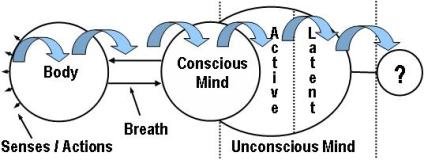
Yoga or "Union" is attained by first training, balancing, and purifying each of the aspects of our being individually, and then systematically receding attention inward through those levels, expanding so as to experience the state of Union, Yoga, Samadhi, or Turiya.
Thursday, January 04, 2007
Sunday, December 31, 2006
Attachment is the Greatest Obstacle to Realization
From Sacred Journey
By Swami Rama
ISBN 8188157007
Reprinted with permission of the Publisher
Copyright Himalayan Institute Hospital Trust
http://hihtindia.org/
ATTACHMENT IS THE GREATEST OBSTACLE TO REALIZATION
Swami Rama
The greatest obstacle in the path of realization is attachment to the body and to the objects of the world. This attachment makes us slaves. It is because of our attachments that we experience fear of death and loss. The more body-conscious and body-attached a person is, the greater the fear of dying.
The same principle applies to people who are attached to the things of the world, to their houses, property, clothing, jewelry, and money. They fear losing those things because they somehow offer meaning, identity, and worth. People also become very attached to other people. The emotion they feel for others gives them an identity and they fear giving up that identity in death. They fear the deaths of those to whom they are attached for similar reasons. If one's identity is somehow defined by attachment to others, the death of others then affects that identity.
The solution is to do away with these attachments to the body, property, possessions, and other people. This point cannot be made often enough. Reducing and finally eliminating attachments does not mean to escape life, to deny the enjoyment of life, or in any way to
diminish life's value. Just the opposite occurs. Life is enhanced, enriched and expanded by reducing attachments. The person learns to love and give and open up to others and to the events of the world.
Attachment means to grip, clasp, grasp, and hold on tightly. When death comes all that was being clutched and grasped is wrenched away. The tighter something is held, the greater will be the wrenching away, the deeper will be the pain. If life has been led with open hands, with no attachments, then death comes but there is nothing to be wrenched away.
We cannot all of a sudden wake one moment and let go of all attachments. It is a lifetime's work to undo the habit of forming attachments and requires attention every day, because the attractions and temptations of the world constantly work to strengthen attachments.
http://swamij.com


Monday, December 25, 2006
Meditation on Form and Formless; Knowledge and Devotion
Audio Pocast:
MEDITATION ON SAGUNA (FORM) AND NIRGUNA (FORMLESS),
KNOWLEDGE AND DEVOTION
Swami Jnaneshvara Bharati
Recorded December 23, 2006
1 hour, 13 minutes, 9 seconds
Click here to listen to the audio Podcast:
http://www.swamij.com/podcast/061223-saguna-nirguna.mp3
This conversation is about Saguna and Nirguna, and the paths of
meditation and contemplation with form or without form, which is
related to the paths of Knowing (Jnana Yoga) and Devotion (Bhakti
Yoga). The discussion involves the approaches individually, and how
the work together. The recording ends with a 17-minute guided
contemplative meditation on either Form or the Formless, which begins
at 55:47.
SWAMIJ.COM AUDIO PODCAST WEB PAGE & ARCHIVES:
http://www.swamij.com/podcast.htm
SWAMI J PODCAST also available through I-Tunes, Podcast.net,
Yahoo.com, Odeo.com and others.
Teaching Meditation to Children
From:
Let the Bud of Life Bloom
A Guide to Raising Happy and Healthy Children
By Swami Rama
ISBN 818815704X
Reprinted with permission of the Publisher
Copyright Himalayan Institute Hospital Trust
http://hihtindia.org/
TEACHING MEDITATION TO CHILDREN
Swami Rama
When you practice meditation, initially you come in touch with
yourself and all your thought patterns; you come to understand your
inner dialogue. Then, you learn to discriminate—to select and reject;
and finally, you learn how to work with yourself. These seeds should
be sown in childhood.
Instead, believers of all faiths, clinging to external rituals,
impose their ideals on their children and force them to participate
in their time-honored customs. Children are taught to love and to
worship pictures of Christ, Krishna, or other gods and goddesses, and
sometimes even community or religious leaders. This does not help
them to become independent or to acquire peace of mind. Children need
to be taught how to cultivate divine virtues within themselves; they
need to be taught how to look within, and how to find within in order
to attain freedom. I think if everyone were to be given a spiritual
education in childhood, they would have fewer problems living in the
world. Without understanding the values of spirituality, with all its
currents and crosscurrents, one becomes lost living in this jungle
that is called world. The world is the real jungle; that which is
considered to be the jungle is not the real jungle.
Most diseases originate in childhood. Children become ill because
they have not learned the means of acquiring peace of mind. Why do
you not lead your children to silence before they learn to be active?
Mothers can do this if they are friends with their children. But
these days mothers have no time. They go out and enjoy themselves
while their children remain at home. The lack of communication
between the younger generation and the parents is creating great
chaos. First of all, you have to learn to respect the family
institution where parents become counselors to their children, and
where children accept their parents, not only as parents, but also as
friends.
When you make meditation a part of your life, your children will
follow your example. Exemplary education is very important for
children. Children imitate their parents; you don't have to teach
them to meditate. Never do that. You should teach your children
through example how to sit quietly and make their minds one-pointed.
When you sit in meditation, your child will also come and sit next to
you and pretend to do what you are doing. In this way the child will
come to know what you are doing and will also form the habit of
sitting with you.
I used to do that in my childhood. When my master would sit in
meditation, I would sit next to him. When I wanted his attention, I
would climb onto his lap. He wouldn't say anything to me, so I would
do something to get his attention. Then he would rub my forehead, and
I did not know what had happened. I am sure I was not sleeping. If
you sit in meditation, and your child comes and sits next to you and
closes his eyes, it is very helpful for the child. Do you think the
child is meditating? I say the child is meditating better than you
are. Even when a child simply imitates you when you are meditating,
it is very helpful for the child.
Meditation is a very powerful thing that gives helpful vibrations to
all. When you meditate, it definitely affects your children. If you
record the brain waves of a child who is sleeping while you are
meditating, you will find a difference. Even your plants and your
pets are affected when you meditate. Instead of imposing your ego or
your emotional problems on your children in the name of discipline,
please discipline yourself, and then your children will also learn.
As a part of our educational training we must define spirituality in
its most precise and universal terms. Spirituality means that which
helps us to discipline our thoughts, speech, and actions; that which
leads us toward the center of consciousness, and thereby helps to
unfold our inner potentials. Education based on such spiritual
guidelines will help humanity to become self-reliant and confident.
Only education based on spirituality can bring harmonious balance to
both our external and inner life.
We need not force children to believe that there is a God. However,
we should provide them with the opportunity to unfold their inner
potentials, to gain confidence, and to become inspired to search for
God according to their own inner tendencies and capacity. For
children to learn to cultivate divine virtues within themselves, the
knowledge of theories that prove the existence of God is not as
important as to learn how to discipline oneself. Through self-
discipline God can be experienced directly.
Spiritual practices, undertaken at an early age, have a profound and
long lasting effect. Human beings have tremendous potential provided
they are taught to train themselves on all levels—physical, mental,
and spiritual. Let us teach our children how to become aware of
themselves on all levels. With a calm and one-pointed mind, children
can obtain a glimpse of true peace and happiness.
The Process of Kundalini Awakening
Excerpted from:
http://www.swamij.com/kundalini-awakening.htm
(There are useful graphics at this link. This newsletter is 1 of 7 sequential web pages at SwamiJ.com on Kundalini Awakening. The other pages are available at the link above.)
THE PROCESS OF KUNDALINI AWAKENING
Swami Jnaneshvara Bharati
KUNDALINI IS INNATE FOR ALL PEOPLE:
At the base of the spine, subtler than the physical body, lies the Kundalini energy, or spiritual energy, in a latent form. Regardless of what religious, spiritual, or meditation tradition one follows, the awakening of this energy, by whatever name you call it, is a most innate and essential part of spiritual advancement, unfoldment, or realization. Awakening kundalini and leading it to union with the Absolute is the goal of the Himalayan sages and the path of Yoga, Vedanta, and Tantra.
http://www.swamij.com/tradition.htm
http://www.swamij.com/yoga-vedanta-tantra.htm
See also the article:
Bindu: Pinnacle of Yoga, Vedanta and Tantra
http://www.swamij.com/bindu.htm
Also, listen to the audio (mp3):
The Secret of Shiva and Shakti
http://swamij.com/Sounds/shiva-shakti-same-swami-j.mp3
http://swamij.com/loop-secret-shiva-shakti.htm
STAGES IN KUNDALINI AWAKENING:
The graphics above display the seven major chakras (section #5), the left and right energies of Ida and Pingala (section #1), and the Sushumna nadi, the central channel that courses through the chakras (Sushumna is sometimes called "silver cord"). The six graphics visually represent the process of Kundalini Awakening. Clicking on each of the six graphics will move you through explanations of the stages. Also, there is an index for the contents of these pages.
http://www.swamij.com/kundalini-awakening-index.htm
The six stages are:
1) Prana usually flow in Ida or Pingala
2) Prana is made to flow in Ida and Pingala
3) Prana is made to flow in Sushumna
4) Kundalini energy is awakened
5) Kundalini is lead upwards
6) Kundalini rises to Sahasrara
NUMBER OF STAGES IN KUNDALINI AWAKENING:
There is nothing especially significant about describing this Kundalini Awakening in six stages (the six graphics), as opposed to some other number; it is simply a convenient way to explain the process. The simplest way of describing the entire process is in three stages:
1) Awakening, opening, or applying Sushumna
2) Awakening Kundalini
3) Kundalini arising to the crown Chakra, Sahasrara
ONE ENERGY WITH MANY NAMES AND FORMS:
There is one energy (Shakti) that keeps taking on new shapes and forms. Each time the energy takes on a new form, we give it a new name. See the article Kundalini, Shakti, and a River for an explanation of these names and forms.
http://www.swamij.com/shakti.htm
SHIVA AND SHAKTI:
Tantra considers the universe to be a manifestation of pure consciousness. Through this process of manifesting, consciousness divides itself into two parts, which, though seeming to be separate, cannot exist without one another.
Shiva remains as a static, formless quality.
Shakti is a dynamic, creative aspect.
SCIENCE AND PHYSICS:
Modern science also considers these two forms of energy, though viewing them in different ways. Science includes, for example, potential energy and kinetic energy (the energy of motion), recognizing that they are both manifestations of the same underlying energy. Tantra describes the unification of all as the pouring out of the energy of consciousness through the manifestation of the static (Shiva) through a veiling and projecting process (Shakti), creating the levels of the universe. At the physical level, modern physics also seeks to find a unifying source, and is in the process of explaining this unification through quark and string theories.
LIKE INK AND THE WORD:
Shiva and Shakti are inseparable and coexist, like ink and the written word, which, though one and the same, are different. With one pen of ink, many different words or images can be manifested, although there remains only one container (pen) of ink. It is that creative process of manifestation that makes the ink appear to have different forms and meaning from one word to the next. When you write different words, or draw both a circle and a square, you have not created a single ink molecule, but have only rearranged the existing molecules, creating the appearance of different words or forms. It remains exactly what it was in the first place, which is ink. This is not negative or merely intellectually reductionistic, but is a most awesome, beautiful process. Similarly, the unmanifest Shiva can manifest into countless forms through the creative appearance of Shakti. Simple metaphors such as ink and written word can be extremely useful to contemplate on, so as to understand the principle of the one appearing to be two, and how these two dance together to form the elegant complexity of manifest reality.
http://www.swamij.com/shakti.htm
EXPERIENCING THEIR UNION:
The journey of Tantra and Kundalini Yoga leads to Kundalini Awakening and to the realization of the Absolute, where these two apparently different aspects of manifestation are experienced in their original union. Yoga means union, or joining, and this union of the static and the dynamic is the meaning of Yoga (see also Yoga Sutras, particularly sutras 1.1-1.4, which define Yoga). Through the process of going ever deeper or higher in practices relating to your own constitution, one repeatedly comes to see the way in which seemingly different realities and self-identities are only apparent, and that manifestation is the mere play of the creative aspect of Shakti with the static aspect of Shiva.
http://www.swamij.com/yoga-sutras.htm
http://www.swamij.com/yoga-sutras-10104.htm
CONCEPTS OF SHIVA AND SHAKTI:
As with many principles of reality, some religious people and traditions conceptualize Shiva and Shakti as anthropomorphic deities, while others view the two as principles and processes of the universe. In either case, the journey of Kundalini Awakening is an inner experience, going from gross to subtle, to subtler, and subtle most, to one's own center of consciousness, by whatever name you choose to call that. In this article, Shiva and Shakti are seen to be the two principles and processes of static and dynamic, as noted several paragraphs above.
See also the article:
Secret of Shiva and Shakti
http://www.swamij.com/shiva-shakti-secret.htm
MEANING OF KUNDA AND KUNDALA:
Kunda means bowl, or cave, and refers to the bowl of fire of consciousness resting in the first chakra at the base of the spine. Lini refers to that which resides in that bowl. Kundala means coiled, as the Shakti forms in a coil there.
MEANING OF SHAK:
The word shak is the root word of Shakti, and means to be able, or to have power. Hence, Kundalini Shakti is the power of consciousness that is coiled in a latent form, in the base of the spine.
EXTERNAL AND INTERNAL PRACTICE:
For those who are lesser prepared, the path of external practices (bahiyayag) is preferred, which may include external forms of rituals or symbolic gestures. For those who are prepared, the path of internal practices (antaryag) is available, which involves making the mind one-pointed and doing introspection.
KAULA, MISHRA, AND SAMAYA TANTRA:
The three schools of tantra are kaula, mishra, and samaya. The kaula school starts with the lower chakras, and involves external practices. The mishra school also works with external practices, and emphasizes the central chakras. The samaya school is the highest, emphasizing the upper chakras. It involves no external practices, focusing only on the inner (antaryag) practices. (The Tantra practice of Yoga Nidra is extremely effective in opening, balancing and purifying the chakras. See also the page describing the Yoga Nidra CD.)
http://www.swamij.com/tantra.htm
http://www.swamij.com/yoga-nidra.htm
http://www.swamij.com/cd-yoga-nidra.htm
REGULATING THE PRIMITIVE INCLINATIONS:
Before treading the later stages of Kundalini Awakening, it is very important to manage the basic urges. Otherwise, the surge of energy may not be handled very well. This means regulating the four primitive fountains of food, sleep, sex, and self-preservation.
http://www.swamij.com/lifestyle.htm
SPONTANEOUS KUNDALINI AWAKENING:
The approach of these writings is to describe the systematic process of intentional Kundalini Awakening. However, it may also come spontaneously to people who have done no intentional practices. One may argue that spontaneous awakening may be coming as a result of previous practices that are not remembered, but in either case the perception of the individual may be that nothing was done to bring forward the experience.
INTEGRATING THE EFFECTS:
Regardless of whether Kundalini Awakening comes spontaneously or through practices, there may be some amount of time and effort needed to integrate the effects of such experiences into the body and personality. It is a time when stabilizing actions are important, including daily exercise, high quality food, regular sleep patterns, and healthy relationships with other people. During this time is very useful to be around someone who has knowledge of this process, and has experienced it personally.
PREPARATION IS MOST IMPORTANT:
Preparation is much more important than the practices of Kundalini Awakening themselves. If one skips the basics and the preparation of body, breath, and mind, then the surge of energy can be more disruptive than beneficial. In the Himalayan tradition Yoga, Vedanta, and Tantra go together, with a solid foundation being built first. The practices of yoga nidra and bhuta shuddhi (chakra meditation) can be quite useful.
http://www.swamij.com/yoga-vedanta-tantra.htm
http://www.swamij.com/yoga-nidra.htm
http://www.swamij.com/chakra-meditation.htm
Sunday, December 17, 2006
Stages of Meditation, Subtle Experiences, Obstacles to Meditation
AUDIO PODCAST: This is a conversation on the stages of meditation dealing with senses and actions, body, breath, the various levels of mind, and that which is beyond the mind. It centers around a graphic on the home page of SwamiJ.com that shows these stages, along with a question mark representing that which is beyond. We also talk about subtle experiences of meditation, obstacles to enlightenment, yoga sutras, and balancing living in the world and the highest goal of life.
Click here to open the podcast
The podcast can be also be accessed through SwamiJ.com:
SwamiJ.com podcast page
The podcast can be also be accessed through any of the following links:
iTunes
Yahoo.com
Podcast.net
Odeo.com
(You can subscribe to the podcast through iTunes, Podcast.net, Yahoo.com, and Odeo.com. The podcast sites take up to 24 hours to post, and may not be updated at the time you are reading this blog.)
Friday, December 15, 2006
Attention, Concentration, Meditation and Samadhi
QUESTION: Is Dharana just "meditation" in an advanced state?
RESPONSE: Remember that "meditation" is an English word that is used in many different ways by different people. Most often, however, "meditation" is linked with "dhyana". It is extremely common in English speaking cultures to use the word "meditation" for any form of attention or concentration. Hence, for example, we have "meditation music" where the person is not at all concentrating in the strictest sense of the word, but is instead just listening to music (which is useful and pleasant, though not meditation as dharana).
There is a sequence:
Attention leads to concentration (dharana).
Concentration leads to meditation (dhyana).
Meditation (dhyana) leads to absorption (samadhi).
Like most arts or sciences, yoga has its own language, which is usually Sanskrit. The terms are more specific than the English words. English words are fine, once we understand the context of their use.
See also Yoga Sutras 3.1-3.3 - http://www.swamij.com/yoga-sutras-30103.htm
Subscribe to:
Posts (Atom)


