Attaining Yoga or Union:

Attaining Yoga or Union:
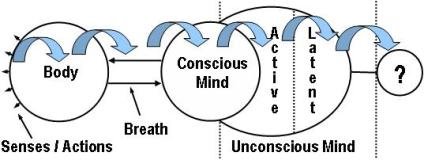
Yoga or "Union" is attained by first training, balancing, and purifying each of the aspects of our being individually, and then systematically receding attention inward through those levels, expanding so as to experience the state of Union, Yoga, Samadhi, or Turiya.

Wednesday, May 28, 2008

VIDEO (3:40 min): Meditation on the small and the large - Yoga Sutra

NEW VIDEO (3:40 Minutes)

MEDITATION ON THE SMALL AND THE LARGE
By Swami Jnaneshvara Bharati

VIDEO at YouTube:
http://www.youtube.com/watch?v=wzQ1eYR5BfA

When the mind in meditation can be stable on the smallest and the largest, then it is truly under control. Yoga is the mastery, integration, and transcendence of all the fluctuations of the mind field. Then the "seer" rests in its own true nature as pure consciousness or purusha. With equality of purusha and the subtlest intelligence, there comes liberation, and that is the end. (from the Yoga Sutras of Patanjali)

For more information please see:
http://www.swamij.com/yoga-sutras.htm

VIDEO (9 min): Yantra and Mantra of Sri Vidya Tantra Yoga

NEW VIDEO (9:10 Minutes)

YANTRA AND MANTRA OF SRI VIDYA TANTRA YOGA
By Swami Jnaneshvara Bharati

VIDEO at YouTube:
http://www.youtube.com/watch?v=bd-Pslr4GIw

In the Himalayan tradition, the aspirant breaks through the final
barrier through Samaya Tantra and Sri Vidya, after clearing the mind
through the practice of Yoga meditation as codified in the Yoga
Sutras by Patanjali, and practicing self-enquiry through Vedanta.
Vidya means knowing, and Sri Vidya is the highest of all aspects of
knowing, as it leads to the Absolute Truth. Yantra refers to the
visual form, and Sri Yantra is the form of that knowing. Central to
the practices is Maha-Tripura-Sundari, the great, beautiful one,
essence, consciousness, or reality that dwells in the three "cities"
(tri-pura, or three cities including: gross, subtle, causal; waking,
dreaming, sleeping; conscious, unconscious, subconscious). Sri (or
Shri) is conceptualized as the feminine creative force of Shakti that
is ultimately found to be one and the same with the static
conceptualized as masculine or Shiva.

For more information please see:
http://www.swamij.com/tantra.htm

Saturday, May 24, 2008

AUDIO (41 min): Theism, Atheism, Nondualism, Contemplation, and Shaktipat

THEISM, ATHEISM, NONDUALISM, CONTEMPLATION, AND SHAKTIPAT
Swami Jnaneshvara Bharati

AUDIO RECORDING (PODCAST)
(41:33 minutes)
http://www.swamij.com/podcast/080223-swami-j-cnd-conf.mp3

YOUTUBE VERSION:
http://www.youtube.com/watch?v=X7QqMmKa1go

Presentation by Swami Jnaneshvara Bharati at the annual conference of the Center for Non-Dualism in Fort Walton Beach, Florida on February 23, 2008. The talk blends three topics: 1) Theism, Atheism, and Non-Dualism; 2) How do I contemplate? What are "great" contemplations? 3) What is shaktipat? How does it work?

See also:
Center for Nondualism:
http://www.centerfornondualism.org

Theism, Atheism, Yoga, and Fear:
http://www.swamij.com/theism-atheism-yoga-fear.htm

Is Yoga a Religion?
http://www.swamij.com/religion.htm

Mysticism, Yoga, and Religion:
http://www.swamij.com/mysticism-yoga-religion.htm

Friday, March 07, 2008

Stages of Yoga Vedanta Meditation and Contemplation

Mahavakyas (great contemplations)
http://www.swamij.com/mahavakyas.htm

STAGES OF YOGA VEDANTA MEDITATION AND CONTEMPLATION
Swami Rama

Meditation and contemplation are two different techniques, yet they are complementary to each other. Meditation is a definite method of training oneself on all levels – body, breath, conscious mind, and unconscious mind – while contemplation builds a definite philosophy. Without the support of a solid philosophy, the method of meditation does not lead to higher dimensions of consciousness.

Contemplation makes one aware of the existence of the Reality, but Reality can be experienced only through the higher techniques of meditation. In the Vedanta system, meditation and contemplation are both used. When an aspirant tires of meditation because of lack of endurance, then he contemplates on the mahavakyas [great contemplations] and studies those scriptures that are helpful in the path of Self-realization and enlightenment. Contemplation, vichara, complements the Vedantic way of meditation, dhyana.

In Vedanta philosophy, there is a definite method used for contemplation. Ordinarily, the mind remains busy in self-dialogue, entangled in the web of its thought patterns. Because of desires, feelings, and emotions, unmanageable conflicts are created in one's mental life. But the Vedanta way of contemplating transforms the entire personality of the aspirant, for the statements, mahavakyas, imparted by the preceptor create a dynamic change in the values of his life. These statements are compact, condensed, and abstruse srutis and cannot be understood without the help of a preceptor who is fully knowledgeable of the scriptures and these terse texts. Only a realized teacher can impart the profundity of such knowledge in a lucid language.

The thoughts, feelings, and desires which were once important to the aspirant lose their value, for he has only one goal to attain. The glory of contemplation brings a dynamic transformation to the internal states of the aspirant. This seems to be very necessary, because that which creates a barrier or becomes an obstacle for students loses its strength due to the power of contemplation, which transforms all his internal states.

First, an aspirant attentively listens to the sayings of the Upanishads from a preceptor who is Brahman-conscious all the time.

In the second step, he practices vichara (contemplation), which means that he goes to the depths of the great sayings and determines to practice them with mind, action, and speech.

One-pointed devotion, full determination, and dedication lead him to the higher step called nididhyasana. Here he acquires comprehensive knowledge of the Ultimate Truth. But he has not yet attained the final step of consciousness that leads him to the direct realization of the one self-existent Truth without second.

The highest state of contemplation is called saksatkara. In this state, perception and conceptualization are in complete agreement, and all the doubts from all levels of understanding vanish forever. At this height of knowledge, truth reveals itself to the aspirant, and perfect realization is accomplished, "I am Atman – I am Brahman." This state of advaita is attained by the process of contemplation. Meditation plays an entirely different role and helps the aspirant make his mind one-pointed, inward, and steady.

Steadiness and stillness are practiced from the very beginning in this meditational method. The method of sitting, the method of breathing, the method of concentration, and the method of allowing a concentrated mind to flow uninterruptedly are subsequent steps that help the aspirant to expand his capacity so that he can contemplate without distraction.
Sunday, March 02, 2008

VIDEO (2 min): What Yoga has Become in America

NEW VIDEO (2:00 Minutes)

What Yoga has Become in America
By Swami Jnaneshvara Bharati

VIDEO at YouTube:
http://www.youtube.com/watch?v=An4LwizAVFo

For more information about what Yoga has become in America, please see:
http://www.swamij.com/traditional-yoga.htm

VIDEO: Diaphragmatic Breathing for Advanced Yoga Meditation

NEW VIDEO (5:34Minutes)

Diaphragmatic Breathing for Advanced Yoga Meditation
By Swami Jnaneshvara Bharati

YouTube link:
http://www.youtube.com/watch?v=cc_fQMdKJqU

MySpace link:
http://myspacetv.com/index.cfm?fuseaction=vids.individual&videoid=27355180

Proper diaphragmatic breathing is a central foundation practice for
one who wishes to move on to advanced meditation, to experience the
highest direct experiences of Yoga. One of the challenges to
breathing diaphragmatically is in knowing exactly where the diaphragm
is located, and how it works. When breathing diaphragmatically, the
muscles of the abdomen, chest, and clavicles are not involved. They
remain still, while the diaphragm gently contracts on inhalation, and
releases on exhalation. Breath is an extremely useful part of the
systematic process of Yoga meditation, which leads one beyond the
breath to the finer, subtler practices and experiences. There is
tremendous value in understanding the process of breathing, and in
diligently, gently practicing diaphragmatic breathing.

http://www.swamij.com/

AUDIO: Theism, Atheism, Nondualism, Contemplation, and Shaktipat

THEISM, ATHEISM, NONDUALISM, CONTEMPLATION, AND SHAKTIPATSwami Jnaneshvara Bharati

AUDIO RECORDING (PODCAST)
(41:33 minutes)
http://www.swamij.com/podcast/080223-swami-j-cnd-conf.mp3

Presentation by Swami Jnaneshvara Bharati at the annual conference ofthe Center for Non-Dualism in Fort Walton Beach, Florida on February23, 2008. The talk blends three topics: 1) Theism, Atheism, and Non-Dualism; 2) How do I contemplate? What are "great" contemplations? 3)What is shaktipat? How does it work?