a book by William J. Broad
Attaining Yoga or Union:
Yoga or "Union" is attained by first training, balancing, and purifying each of the aspects of our being individually, and then systematically receding attention inward through those levels, expanding so as to experience the state of Union, Yoga, Samadhi, or Turiya.
Saturday, December 29, 2012
Review of The Science of Yoga
a book by William J. Broad
Tuesday, January 24, 2012
Real Yoga Will Not Wreck Your Body
~Swami Jnaneshvara Bharati
Wednesday, February 18, 2009
VIDEO (8:12 min): The Truth about the 10 Reasons for Yoga
THE TRUTH ABOUT THE 10 REASONS FOR YOGA
By Swami Jnaneshvara Bharati
http://www.swamij.com/
VIDEO is at YouTube:
http://www.youtube.com/watch?v=mwcKxsYHm3c
Yoga Day USA lists "Top 10 Reasons to Try Yoga for Life"
on their website www.YogaDayUSA.org
Unfortunately, most of their
reasons have little to do with
authentic, traditional Yoga.
REASON #1. YOGA FOR … STRESS RELIEF:
Yoga reduces the physical effects of stress on
the body. By encouraging relaxation, yoga helps
to lower the levels of the stress hormone cortisol.
Related benefits include lowering blood pressure
and heart rate, improving digestion and boosting
the immune system as well as easing symptoms
of conditions such as anxiety, depression, fatigue,
asthma and insomnia.
THE TRUTH ABOUT YOGA:
Most people in the West, and also many in India,
confuse Yoga with Hatha Yoga, the system of
bodily postures. But Yoga is primarily a spiritual
discipline.
(Paramahansa Yogananda)
REASON #2. YOGA FOR … PAIN RELIEF:
Yoga can ease pain. Studies have demonstrated that
practicing yoga asanas (postures), meditation or a
combination of the two, reduced pain for people
with conditions such as cancer, multiple sclerosis,
auto-immune diseases and hypertension as well as
arthritis, back and neck pain and other chronic
conditions. Some practitioners report that even
emotional pain can be eased through the practice
of yoga.
THE TRUTH ABOUT YOGA:
Yoga has become the health and fitness system
of choice. This is odd because it is the mind -
not the body - that is the main target of all genuine
Yoga practices .... To regard Yoga primarily as a
set of practices for increasing strength and
flexibility while calming the nervous system is
to mistake the husk for the kernel.
(Pandit Rajmani Tigunait)
REASON #3. YOGA FOR … BETTER BREATHING:
Yoga teaches people to take slower, deeper breaths.
This helps to improve lung function, trigger the
body's relaxation response and increase the amount
of oxygen available to the body.
THE TRUTH ABOUT YOGA:
Like many arts and sciences that are profound,
beautiful, and powerful, yoga has suffered from
the spiritual poverty of the modern world--it has
been trivialized, watered down, or reduced to
cliches. The deep and eternal essence of yoga
has been misrepresented and packaged for
personal profit by clever people.
(Bhole Prabhu)
REASON #4. YOGA FOR … FLEXIBILITY:
Yoga helps to improve flexibility and mobility,
increasing range of movement and reducing aches
and pains. Many people can't touch their toes during
their first yoga class. Gradually they begin to use the
correct muscles. Over time, the ligaments, tendons
and muscles lengthen, increasing elasticity, making
more poses possible. Yoga also helps to improve body
alignment resulting in better posture and helping to
relieve back, neck, joint and muscle problems.
THE TRUTH ABOUT YOGA:
In ancient times hatha Yoga was practiced for
many years as a preparation for higher states of
consciousness. Now however, the real purpose
of this great science is being altogether forgotten .
The hatha Yoga practices which were designed
by the rishis and sages of old, for the evolution
of mankind, are now being understood and
utilized in a very limited sense.
(Swami Satyananda Saraswati)
REASON #5. YOGA FOR … INCREASED STRENGTH:
Yoga asanas (postures) use every muscle in the
body, helping to increase strength literally from
head to toe. And, while these postures strengthen
the body, they also provide an additional benefit
of helping to relieve muscular tension.
THE TRUTH ABOUT YOGA:
Yoga is not mere acrobatics . Some people suppose
that Yoga is primarily concerned with the
manipulation of the body into various queer
positions, standing on the head, for instance, or
twisting about the spine, or assuming any of the
numerous odd poses which are demonstrated in
the text-books on Yoga. These techniques are
correctly employed in one distinct type of Yoga
practice, but they do not form an integral part of
the most essential type. Physical posture serve
at best as an auxiliary, or a minor form of Yoga.
(Swami Chidananda Saraswati)
REASON #6. YOGA FOR …
WEIGHT MANAGEMENT:
Yoga (even less vigorous styles) can aid weight
control efforts by reducing the cortisol levels
as well as by burning excess calories and
reducing stress. Yoga also encourages healthy
eating habits and provides a heightened sense of
well being and self esteem.
THE TRUTH ABOUT YOGA:
Many false and incomplete teachings have been
propagated in its name, it has been subject to
commercial exploitation, and one small aspect
of Yoga is often taken to be all of Yoga. For
instance, many people in the West think it is a
physical and beauty cult, while others think it
is a religion. All of this has obscured the real
meaning of Yoga.
(Swami Rama)
REASON #7. YOGA FOR …
IMPROVED CIRCULATION:
Yoga helps to improve circulation and, as a result
of various poses, more efficiently moves
oxygenated blood to the body's cells.
THE TRUTH ABOUT YOGA:
Through the discipline of Yoga, both actions and
intelligence go beyond these qualities [gunas] and
the seer comes to experience his own soul with
crystal clarity, free from the relative attributes of
nature and actions. This state of purity is samadhi.
Yoga is thus both the means and the goal. Yoga
is samadhi and samadhi is Yoga.
(B. K. S. Iyengar)
REASON #8. YOGA FOR …
CARDIOVASCULAR CONDITIONING:
Even gentle yoga practice can provide cardio-vascular
benefits by lowering resting heart rate, increasing
endurance and improving oxygen uptake during
exercise.
THE TRUTH ABOUT YOGA:
The main objective of hatha Yoga is to create an
absolute balance of the interacting activities and
processes of the physical body, mind and energy.
When this balance is created, the impulses
generated give a call of awakening to the central
force (sushumna nadi) which is responsible for
the evolution of human consciousness. If hatha
Yoga is not used for this purpose, its true
objective is lost.
(Swami Satyananda Saraswati)
REASON #9. YOGA FOR …
FOCUS ON THE PRESENT:
Yoga helps us to focus on the present, to become
more aware and to help create mind body health.
It opens the way to improved concentration,
coordination, reaction time and memory.
THE TRUTH ABOUT YOGA:
The goal of Yoga is Yoga itself, union itself, of the
little self and the True Self, a process of awakening
to the preexisting union that is called Yoga.
Yoga has to do with the realization through direct
experience of the preexisting union between Atman
and Brahman, Jivatman and Paramatman, and
Shiva and Shakti, or the realization of Purusha
standing alone as separate from Prakriti.
(Swami Jnaneshvara Bharati)
REASON #10. YOGA FOR … INNER PEACE:
The meditative aspects of yoga help many to reach
a deeper, more spiritual and more satisfying place
in their lives. Many who begin to practice for
other reasons have reported this to be a key reason
that yoga has become an essential part of their
daily lives.
(This finally touches on the real reasons for Yoga
by mentioning that it is for "spiritual" reasons.)
THE TRUTH ABOUT YOGA:
You use the body as a medium to bring the mind
back to the brain. Perfect marriage between body
and mind. Then, you can reach and knock the
door to the spirit....
Yoga is free. It belongs to the earth. It's a god.
(Bikram Choudhury)
Distortion of Yoga Nidra (addendum to the Yoga Nidra article)
Distortion of Yoga Nidra
(addendum to the Yoga Nidra article)
The distortion of the very high practice of Yoga Nidra is so thorough in the world these days that it seems necessary to make very bright titles just to have the point noticed.
Throughout this article (and others linked on this page) you will find explanations that there are THREE levels of consciousness: Waking, Dreaming, and Deep Sleep (plus the "fourth" which is the transcendent state known as Turiya). Yoga Nidra is conscious DEEP SLEEP and Deep Sleep is NOT conscious Dreaming. Yoga Nidra is also NOT the transition between Waking and Dreaming. Those are states to explore, but they are NOT Deep Sleep; if it did have dreams, that would be called Dreaming, and would NOT be called Deep Sleep.
It is utterly obvious that Deep Sleep does NOT have Dreams to explore. It should be self-evident that Dreaming and Not-Dreaming (i.e., Deep Sleep) are two different things. However, books, articles, and CDs keep telling people that Yoga Nidra is a state of Dreaming, or transitioning into Dreaming from Waking. This is just not true. Throughout the ancient writings of the yogis, sages, and rishis there are explanations of these three states of consciousness. Please don't just take my word for it. Read the ancient writings, including Vedas, Upanishads, Bhagavad Gita, and others. You will find these states talked about over and over, and over again.
Many people are now practicing all sorts of guided imageries in the name of Yoga Nidra so that they can make money, have better sex, or manipulate other people. There are CDs out which say Yoga Nidra is for "this or that" named disease or other specific desire-based purpose. Yoga Nidra has been made to sound like "The Law of Attraction," whereby you fulfill your desires through meditative techniques.
Yoga Nidra was taught by the ancient sages for the purpose of exploring the deep impressions or samskaras, which drive our actions or karma. They taught this so that sincere seekers can purify the deeper aspect of the mind-field, which is accessed in the formless state of conscious Deep Sleep. If I try to explain the whole process here in this paragraph, I would have to condense the whole article here, which can't be done. You must do this exploration yourself. Read the article. Read the other articles. Read the texts mentioned above.
I'm not writing this here just to complain about other people. The fact is, that Yoga Nidra is a profoundly useful and deep practice for enlightenment at this highest level of that word (enlightenment). The term "Yoga Nidra" has become so watered-down, so distorted that sincere seekers are not likely to see the extremely high value of authentic Yoga Nidra. If you read this, research this yourself, and then do the practices, you'll discover for yourself the very high value of authentic, traditional Yoga Nidra.
I know that all of this can sound like a "sales pitch." Well, we're stuck with that. I'm writing this here so that possibly some few sincere people will move forward with authentic Yoga Nidra. There are a small handful of people out there who can talk to you about this, and guide you. I'm not going to recommend any specific names of people, however. Just explore sincerely; you'll find your way to the real thing of Yoga Nidra.
While you are here, reading this part of the article, please read carefully the rest of the article, as well as some of the other articles about these three levels of consciousness (levels articles), particularly the third level, which is the domain of Deep Sleep. I know it can be a difficult read, but there's great value in understanding these levels of consciousness and how Yoga Nidra is used as a tool for higher experience.
Yoga Nidra is NOT the Dreaming state.
Yoga Nidra IS conscious Deep Sleep.
AUDIO (34 min): Developing Determination for Enlightenment
Swami Jnaneshvara Bharati
AUDIO RECORDING (PODCAST)
(34:20 minutes)
http://www.swamij.com/podcast/determination-090201.mp3
From a presentation at the Center for Nondualism on February 1, 2009.
http://centerfornondualism.org/
http://www.swamij.com/
The Meaning and Purpose of Yoga
THE MEANING AND PURPOSE OF YOGA
By Bhole Prabhu
Like many arts and sciences that are profound, beautiful, and
powerful, yoga has suffered from the spiritual poverty of the modern
world--it has been trivialized, watered down, or reduced to cliches.
The deep and eternal essence of yoga has been misrepresented and
packaged for personal profit by clever people. At the hands of some,
yoga has been reduced to the status of just another exercise program
available on videotape. In other contexts, yoga has been presented as
a cult religion, aimed at attracting "devotees." Such a haze of
confusion has been created around the clear and pure concept of yoga
that it is now necessary to redefine yoga and clarify its meaning and
purpose.
Yoga defines itself as a science--that is, as a practical, ethodical,
and systematic discipline or set of techniques that have the lofty
goal of helping human beings to become aware of their deepest nature.
The goal of seeking to experience this deepest potential is not part
of a religious process, but an experiential science of self-study.
Religions seek to define what we should believe, while a practical
science such as meditation is based on the concrete experience of
those teachers and yogis who have previously used these techniques to
experience the deepest Self. Yoga does not contradict or interfere
with any religion, and may be practiced by everyone, whether they
regard themselves as agnostics or members of a particular faith.
Throughout history, yogic techniques have been practiced in both the
East and West, so it would be an error to consider yoga an "Eastern
import." In fact, yoga, with its powerful techniques for creating a
sense of inner peace, harmony, and clarity of mind, is absolutely
relevant to the modern world--both East and West. Given the increasing
pace and conflict present in modern life, with all its resulting
stress, one could say that yoga has become an essential tool for
survival, as well as for expanding the creativity and joy of our lives.
THE LIVING TRADITION
Although yoga does not "belong" to the East, it is easiest to trace
its roots there, because cultural change has not obscured the origins
of the science, and an ongoing tradition of yoga has continued to the
present day. No one person "invented" yoga--yoga is a living
tradition, a set of practices that dates back for centuries. These
practices were codified by a scholar and teacher named Patanjali in
The Yoga Sutras, written about the second century B.C.
The most important teaching of yoga has to do with our nature as human
beings. It states that our "true nature" goes far beyond the limits of
the human mind and personality--that instead, our human potential is
infinite and transcends our individual minds and our sense of self.
The very word "yoga" makes reference to this. The root, "yuj" (meaning
"unity" or "yoke"), indicates that the purpose of yoga is to unite
ourselves with our highest nature. This re-integration is accomplished
through the practices of the various yoga disciplines. Until this
re-integration takes place, we identify ourselves with our
limitations--the limitations of the body, mind, and senses. Thus we
feel incomplete and limited, and are subject to feelings of sorrow,
insecurity, fear, and separation, because we have separated ourselves
from the experience of the whole.
In the modern world we have become quite successful in our external
achievements--we have created powerful technologies and a variety of
products, we are obsessed with accumulating power, wealth, property
and objects--and yet we have not been able to create either individual
or social peace, wisdom, or happiness. We have only to look around and
see the destructiveness of our weapons, the emptiness of our pleasures
and entertainments, the misuse of our material and personal resources,
the disparities between rich and poor, and above all, the loneliness
and violence of our modern world. We see that amid all our success in
the external world, we have accomplished little of lasting value.
These problems will not be solved through new technological
developments. Instead, the resolution to these human problems will
come only when we discover within ourselves that for which all of
mankind is searching--inner peace, tranquility, and wisdom. This
attainment is the goal of yoga, for yoga is the practical science
intended to help human beings become aware of their ultimate nature.
AN ASCENT INTO PURITY
The process of yoga is an ascent into the purity of the absolute
perfection that is the essential state of all human beings. This goal
requires the removal of our enveloping personal impurities, the
stilling of our lower feelings and thoughts, and the establishment of
a state of inner balance and harmony. All the methods of yoga are
based on the perfection of our personalities and may help to create a
new world order.
In the beginning of our work, the greatest problem we experience is
our inherent restlessness of mind. Mind, by its very nature, is
outgoing and unsteady. The highest state of meditation, however,
requires a calm, serene, one-pointed mind, free from negative emotions
and the distractions created by cravings, obsessions, and desires. To
reach the subtler levels of consciousness and awareness, we need
willpower, clarity of mind, and the ability to consciously direct the
mind towards our goal. This is possible only when we turn away from
preoccupation with external acquisition and seek to stop all
inharmonious or negative mental processes. To achieve this, we do not
need to give up our homes and society and retire to a monastery.
Instead, we can achieve a state of peace, harmony, and contentment in
our daily meditation, and thus, go on carrying out our life's duties
and activities with the love and devotion that emerges from our
meditative experience.
For those who want to follow the path of yoga towards peace and
evolution, there are a few prerequisites. We need good health, a calm
mind, sincerity, and a burning desire to rise above our human
imperfections. Our health is maintained by a simple and well-
regulated diet, adequate sleep, some physical exercise, and
relaxation. Imbalance or excesses in food, exercise, sleep, or our
personal relationships produce physical and emotional disruptions that
disturb the practice of yoga and meditation.
If the aspects of our daily lives are well balanced, then certainly we
can make progress in yoga in the modern world. Regardless of where we
live or what we do, we can create a life conducive to yoga.
PATHS TO THE SUMMIT
As we indicated earlier, there is much confusion about exactly what
yoga is, especially since there seem to be so many approaches, all
described by the name "yoga." A mountain climber may take a variety of
routes to reach the top of a mountain. From the plain at the base of
the mountain, all these paths seem distinct and different, but from
the mountain summit, the view is always the same! The same is true of
the seeming diversity of the yogic paths. These different paths are
not mutually exclusive or conflicting, but are intended to accommodate
the various inclinations, personalities, and temperaments of
individual students, and yet they all have the same goal. These
various paths of yoga include:
1) Hatha yoga, which deals mostly with body and breathing exercises
that help the student to become aware of his or her internal states.
Hatha yoga exercises help to make the body a healthy and strong
resource for the student.
2) Karma yoga, which means "the yoga of action." This path teaches us
to do our own duties in life skillfully and selflessly, dedicating the
results of our actions to humanity. Practicing this aspect of yoga
helps us to live unselfishly and successfully in the world without
being burdened or distressed.
3) Jnana yoga is the path of knowledge and wisdom. This path involves
intense mental discipline. Knowledge dawns as we learn to discriminate
between the real and the unreal, between the transient and the
everlasting, between the finite and the infinite. This path is meant
for only a fortunate few, who are aware of the higher and subtler
realities of life.
4) Bhakti yoga is the yoga of devotion. This path is the way of love
and devotion. It is the path of self-surrender, of devoting and
dedicating all human resources to attaining the ultimate reality.
5) Kundalini yoga is a highly technical science. The guidance of a
competent teacher is required to learn methods for awakening the
serpent-like vital force that remains dormant and asleep in every
human body.
6) Mantra yoga, which involves meditation and the use of certain
sounds called "mantras," which are traditionally transmitted to the
student, and are used as objects of concentration. Mantras help the
student in self-purification, concentration, and meditation. These
mantras were discovered in deep meditation by highly advanced sages
and teachers.
Finally, there is raja yoga, the "royal path" which is very scientific
and thorough. By following this path methodically, we learn to refine
our desires, emotions, and thoughts, as well as the subtle impressions
and thoughts that lie dormant in the unconscious mind. Raja yoga helps
us to experience the inner reality by using an eight-runged ladder.
The ultimate goal is for the aspirant to attain the eighth rung, samadhi.
THE ROYAL PATH
Raja yoga encompasses teachings from all the different paths. Because
of its variety it can be practiced by people of many backgrounds and
temperaments. It involves all three dimensions of human interaction--
physical, mental, and spiritual. Through this path, we achieve balance
and harmony of all three levels and then attain full realization of
the Self.
Raja yoga is a scientific discipline that does not impose
unquestioning faith, but encourages healthy examination. Certain
practices are prescribed and the benefits derived from them are
described so that this path can be scientifically verified by anyone
who experiments with the methods. Because of this, raja yoga is
ideally suited to the modern world, in which scientific skepticism is
so prominent.
Raja yoga is also called astanga yoga, or "the eight-fold path,"
because its eight steps create an orderly process of self-
transformation beginning on the level of the physical body, and
eventually involving the subtler levels of life. The eight steps are
yama, niyama, asana, pranayama, pratyahara, dharana, dhyana, and samadhi.
EXTERNAL PRACTICES
The first four rungs or steps--yama, niyama, asana, and pranayama,
comprise the path of hatha yoga, which is preparatory to the last four
stages of raja yoga.
Yama and niyama are ten commitments of attitude and behavior. One set
of disciplines (niyama) is meant to improve the human personality and
the other (yama) is meant to guide our relationships and interactions
with other beings in the world. Thus yoga is an education for both
internal and external growth.
The five yamas, or restraints, are nonviolence, truthfulness,
nonstealing, sensual moderation, and non- possessiveness. Their
practice leads to changes in behavior and emotions, in which all
negative emotions are replaced by positive ones. The five niyamas, or
observances, are cleanliness (both external and internal),
contentment, practices which bring about perfection of body and senses
(tapas), study of the scriptures, and surrender to the ultimate
reality. The niyamas lead to the control of our behavior and
eventually are extremely positive factors in developing the personality.
In the beginning we should not be discouraged by the challenge of
these first two steps. For example, even before we have succeeded in
developing the trait of nonviolence completely, we will see increasing
peace in our lives and meditation as a result of attempting to
practice this yama.
Usually, when hatha yoga is taught in the modern world, only asanas
(physical postures) and certain breathing practices are taught. Yama
and niyama often are ignored. Because of this, hatha yoga has become
somewhat superficial, sometimes emphasizing only physical beauty or
egoism about skill and strength in postures. Certainly asanas and
breathing exercises create physical health and harmony, but only when
our minds are free from violent emotions can we achieve a calm,
creative, and tranquil mental state.
Actually, there are two types of asanas--meditative postures and
postures that ensure physical well-being. A stable meditative posture
helps us create a serene breath and calm mind. A good meditative
posture should be comfortable and stable, ensuring that the head,
neck, and trunk are erect and in a straight line. If the body is
uncomfortable, it makes the mind agitated and distracted. The second
kind of postures are practiced to perfect the body, making it limber
and free from disease. These postures stimulate specific muscles and
nerves and have very beneficial effects.
The fourth step of raja yoga is pranayama. Prana is the vital energy
that sustains body and mind. The grossest manifestation of prana is
the breath, so pranayama is also called the "science of breath." These
exercises lead to calming and concentration.
INTERNAL PRACTICES
The four steps of hatha yoga prepare the student for the four internal
practices of raja yoga. These internal practices are pratyahara,
dharana, dhyana, and samadhi.
The fifth step of raja yoga is pratyahara or withdrawal and control of
the senses. While we are awake, the mind becomes involved with the
events, experiences, and objects of the external world through the
five senses of sight, hearing, touch, taste, and smell. The mind
constantly gathers sensations from the external world through these
senses and our mind reacts to them. To attain inner calmness, the
student of yoga will want to develop the ability to voluntarily remove
the distractions of the world outside. This is not a physical process
but a voluntary, mental process of letting go of our involvement with
external sensations.
Our sensory impressions distract the mind when we want it to become
aware of serenity within. Thus, it is useful to learn dharana, or
concentration, the sixth step in raja yoga. In concentration, the
scattered power of the mind is coordinated and focused on an object of
concentration through continued voluntary attention. This voluntary
attention uses a conscious effort of the will, and it is developed
through consistent practice. Through concentration, a scattered, weak
mind is focused and made more powerful.
The seventh step in raja yoga is dhyana, or meditation. Meditation is
the result of continued, unbroken concentration. Concentration makes
the mind one-pointed, calm, and serene. Meditation then expands the
one-pointed mind to the superconscious state. Meditation is the
uninterrupted flow of the mind toward one object or concept. When the
mind expands beyond conscious and subconscious levels and assumes this
superconscious flow, then intuitive knowledge dawns. All the methods
of yoga prepare us to eventually reach this stage of meditation and
thus attain peace, perfection, and tranquility.
In our daily lives, meditation can be very helpful in eliminating many
physical and psychological problems. A significant amount of the
disease we experience is actually either directly or indirectly the
result of conflicts, repression, or emotional distress arising in the
conscious or unconscious mind. Meditation helps us to become aware of
these conflicts and to resolve them, establishing tranquility and
peace. In this way, meditation becomes a powerful resource for facing
the challenges of daily life.
If we really consider how we learn in the modern world, we realize
that despite all our emphasis on education, our education is one-
sided and shallow. We may learn to memorize equations and facts, but
we do not really learn to understand and develop our own inner life.
Our minds remain scattered and our emotions persist as negative,
conflicting forces. We are able to use only a small portion of our
mental abilities, because we are preoccupied with confusion, fear, and
inner conflict. Meditation helps us to overcome these limitations; it
helps us to become aware of the subtler and more positive powers
within. In gaining this awareness, we become creative and dynamic.
Abilities such as intuition, which many consider unusual or rare, are
actually within the potential of all human beings who meditate. Such
gifts are available to those who make contact with the deeper aspects
within themselves.
Prolonged and intense meditation leads to the last step of raja yoga--
the state of samadhi, the superconscious state. In this state we
become one with the higher Self and transcend all imperfections and
limitations. The state of samadhi is the fourth state of
consciousness, which transcends the three normal states of waking,
dreaming, and dreamless sleep.
A person who attains samadhi becomes a gift to his or her society. If
humanity is ever to achieve a more evolved civilization, it will be
possible only because of our growth and evolution as human beings. A
person who is established in samadhi lives his or her whole life as a
spontaneous expression of the unhindered flow of supreme
consciousness. This superconscious level is our human essence; it is
universal and transcends all the divisions of culture, creed, gender
or age. When we become aware of this state within, our whole life is
transformed. When we transform ourselves and experience serenity,
peace, and freedom, we also transform our societies and all of human
civilization. This awareness of the infinite consciousness is the
practical and real goal of yoga.
----
Bhole Prabhu lived in the Himalayas, and was a yogi, poet, and
philosopher renowned as an original thinker.
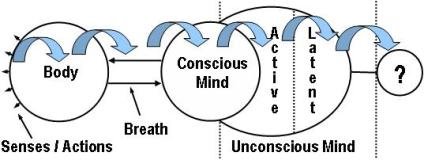
Yoga, Computers and Four Levels of Consciousness
http://www.swamij.com/computers-consciousness.htm
(The whole article is at this link, along with useful pictures)
YOGA, COMPUTERS AND FOUR LEVELS OF CONSCIOUSNESS
By Swami Jnaneshvara Bharati
I am not the picture on my computer monitor.
I am electricity.
I am not the processing in my microchip.
I am electricity.
I am not the data on my hard drive.
I am electricity.
I am the life in all of these three.
I am the electricity.
A MODEL FOR MEDITATION: The computer can be used as a modern metaphor
for understanding the process of Yoga meditation and the levels of
consciousness through which one journeys. By understanding these
levels or stages, it is much easier to understand how meditation is
not used merely as a means of relaxation or psychic experience, but as
the means for the realization of the ever pure, ever joyful core of
our being, by whatever name you choose to call that center.
FOUR LEVELS:
1. Peripherals/Conscious: The ten senses and means of expression
(indriyas), along with the conscious mind, allow the inner person to
communicate and act in the external world, like the peripherals of a
computer system, including monitor, keyboard, speakers, and microphone.
Four functions of mind: Throughout the conscious, unconscious, and
subconscious levels, the four functions of mind operate ever subtler,
until even they are transcended in the fourth stage, noted below.
2. Microchip/Unconscious: The active unconscious mind processes mostly
out of view, with only a small part of its functioning normally coming
to the surface of the conscious mind, like the microchip of the
computer, which does a tremendous amount of processing, yet presents
only a tiny amount of that to the peripherals.
3. Hard-drive/Subconscious: It is consciousness flowing in or through
the deep impressions of the latent subconscious, which causes them to
stir, just like the otherwise inert binary numbers resident on a
hard-drive, which do nothing until they are energetically brought to
life and spring forth into the microchip.
4. Electricity/Consciousness: The conscious, unconscious, and
subconscious levels of mind all function because of the flow of
consciousness, energy, or life force, just as the peripherals,
microchip, and hard-drive all operate because of the electricity. Both
the consciousness and the electricity are uniform, regardless of what
programs might be running in the moment.
I AM THE ELECTRICITY:
I am not the peripherals!: One explores the peripherals, the waking
state, the conscious mind, and the gross world, moving through them in
meditation.
I am not the microprocessor!: One explores the microprocessor, the
dreaming state, the unconscious mind, and the subtle plane, moving
through them in meditation.
I am not the hard-drive!: One explores the hard-drive, the deep sleep
state, the subconscious mind, and the causal plane, moving through
them in meditation.
I am the electricity!: Through deep meditation, one pierces the three
layers described above. Ultimately, one comes to resolve the question,
"Who am I?" in direct experience, with the realization of being the
pure consciousness, energy, or life force that is beyond, higher, or
underneath each of the other three levels, stages, or states, which is
the core of our being.
MORE ARTICLES ON THESE LEVELS OF CONSCIOUSNESS:
http://www.swamij.com/index-yoga-meditation-levels.htm
NEW VIDEO (1 min): Killing, Nonharming, Source of Humans, Yoga Sutra
KILLING, NONHARMING, SOURCE OF HUMANS,
YOGA SUTRAS 2.29 - 2.35
By Swami Jnaneshvara Bharati
http://www.swamij.com/
VIDEO is at YouTube:
http://www.youtube.com/watch?v=fRIOq89tC5s
All humans arise from the same source.
Let's stop killing each other.
Ahimsa = Nonharming
Yoga Sutras 2.29 - 2.35
http://www.swamij.com/yoga-sutras.htm
Wednesday, December 17, 2008
New Website on Teachings of Swami Rama
LINK:
https://sites.google.com/site/swamiramateachings/
DESCRIPTION (from the site)
One of the greatest gifts of Swami Rama to humanity was bringing the depths of the wisdom of the ancient sages of Yoga meditation, Vedanta, and Tantra to the people in highly accessible ways. His style of writing is extremely clear and practical, speaking from the highest perspective of a Himalayan master. The writings on this website are a small sample of that wisdom.
Although Swami Rama was most known for guiding people on the path to the highest spiritual realizations, his finest worldly accomplishment was founding the Himalayan Institute Hospital Trust near Haridwar, Rishikesh, and Dehradun, India. This includes a 750-bed hospital, a 400-student medical college, a 300-student nursing school, the major cancer center in the region, and a rural development program serving over 1000 villages in the region, including the high Himalayas areas of the sages near the source of the River Ganges. HIHT is also the home of Swami Rama Center, which is dedicated to preserving and promoting the teachings of Swami Rama. Swami Rama also founded Sadhana Mandir Ashram, which is located nearby in Rishikesh.
http://hihtindia.org/
http://sadhanamandir.org/
Swami Rama was born in the Himalayas, lived a life of service to humanity, and left the body on November 13, 1996 at his residence on the grounds of the Himalayan Institute Hospital Trust.
QUOTES FROM ARTICLES (from the home page)
The following quotes of Swami Rama are excerpts from the articles linked at the left.
You are the Architect: When a human being learns to seek religion not in gods, but in his own potentials, then he will know that he is great and that within his greatness lies his happiness. When he rapidly unfolds the chapters of life's manuscript, of which he himself is the author, he begins to realize who he is.You are the architect of your life. You build your own philosophy and construct your own attitudes. Without right attitudes, the entire architecture remains shaky. Once you realize this fact, you will look within.(more)
Enlightenment and Freedom: People continue to build shrines, chapels, churches, and temples. You don't have to do this, just realize that you are a living shrine. The day you have attained the knowledge that the Lord lives within you, you will be in samadhi. All questions will be answered, all problems will be resolved. (more)
Knowing Yourself: The aim of life is Self-realization. The saying, "Know thyself," was written on the temple of the oracle at Delphi in ancient Greece. This is where East and West meet. Both East and West agree on this goal, though they might hold different ways of attaining it. The one important part of life is ignored by the educational systems at home, in society, and in the colleges and universities: "Know thyself." You need to understand yourself on all levels. You don't need much external information; you already have true knowledge within. You need to learn how to apply the knowledge that you have. (more)
Arise, Attain, and Serve: Today's society is waiting for selfless, spiritually enlightened, well-balanced leaders to guide them in how to live happily here and hereafter. Such leaders or reformers will not come from outside our society. They have to be born, raised, and trained right in our own society. We are the ones to become our own guides, our own leaders, and we are the ones to enlighten our own lives. Get up, my friends, arise: attain knowledge, and dedicate your life to the service of your fellow beings. (more)
Sushumna: According to the yogic scriptures, there are 72,000 nadis, or energy channels. Among them, ida, pingala, and sushumna are the most important. As long as the mind is outward, only ida and pingala remain active. But when the mind is calm and tranquil, sushumna, the central channel, is awakened. The joy derived from the mind traveling through the sushumna channel is unique; it cannot be compared with any sensory pleasure. Because of that inner joy, the mind loses its taste for worldly pleasures. Sushumna application is the most important factor in spiritual practice. The moment sushumna is awakened, the mind longs to enter the inner world. When the flow of ida and pingala is di¬rected toward sushumna, and distractions are thereby removed, meditation flows by itself. (more)
Keys to Successful Living: Everyone wants to be successful in life, but where are the keys to success? Do we have to go out and search for those keys, or do we have those potentials already within ourselves? When we begin to examine life, we can see that it is divided into two aspects -- life within and life without; internal life and external life -- and we can see that these aspects are of equal importance. Even if we have renounced the world, gone far away from civilization, and live in the wilderness doing nothing but meditation, we cannot ignore external life. We still have to see that we eat, do our ablutions, and perform our practices on time. So life in the external world is as important as life in the internal world. Even one who has renounced the world has to understand the word "relationship" properly, because life itself is actually relationship. (more)
Internal Dialogue: Developing internal dialogue is a very important step, but one that few students understand. To succeed in meditation you have to develop this important step. You do not begin with meditation itself. First you learn to set a regular meditation time, and then to have a dialogue with yourself. In this process you are coming in contact with your inner, internal states. You are learning about the subtle aspects of your mind, your own conscience, and at the same time you are training yourself. (more)
Mantra and Silence: Imagine that you are standing on the bank of a river and you hear the current as it flows. If you follow the river upstream, you will come to its origin. There, you will find that there is no sound. In the same way, a mantra leads the mind to the silence within. That state is called "soundless sound." The seven sounds, or mantras, of the chakras, if magnified, create a form. Each mantra will make a different form. But magnifying sound in the external world is not going to help you. You have to go to the source within, from which that sound comes. This form gives you a knowledge of the sound, and the sound gives you a knowledge of the silence from which all sounds come. (more)
Guru and Divine Grace: Guru is not the goal. Anyone who establishes himself as a guru to be worshipped, is not a guru. Christ, Buddha, and other great persons did not set up any such example. Guru is like a boat for crossing the river. It is important to have a good boat and it is very dangerous to have a boat that is leaking. The boat brings you across the river. When the river is crossed the boat is no longer necessary. You don't hang onto the boat after completing the journey, and you certainly don't worship the boat. (more)
Self Transformation: For a genuine and everlasting transformation, one must practice a systematic method of self-discipline and self-training. Mere philosophy and intellectual knowledge cannot stand in time of need, if one does not know how to use the essentials of that philosophy in one's daily life. Applying theoretical knowledge and living with it in daily life is called practice. Practice requires discipline. Discipline should not be rigidly imposed, but students should learn to commit themselves and accept discipline as essential for self-growth. Imposing rigidity and following it is not helpful at all. (more)
NEW VIDEO (9 min): Trataka and Soham Mantra: Yoga and Tantra Meditation
TRATAKA GAZING WITH SOHAM MANTRA:
YOGA AND TANTRA MEDITATION
By Swami Jnaneshvara Bharati
http://www.swamij.com/
VIDEO is at YouTube:
http://www.youtube.com/watch?v=VBASQ314m7c
Trataka is gazing, and is a traditional meditation practice of Yoga
and Tantra.
SoHum (or SoHam) is a Universal Mantra, as it relates to the breath,
and everybody breaths.
SoHum is a Sanskrit word that means
"I am that," or "I am that I am."
Inhale with the sound "So,"
And Exhale with the sound "Hum."
Allow the sounds to silently repeat in your mind,
without speaking them aloud.
There are a total of 40 SoHum and breath repetitions
The speed of one repetition is 9 seconds per breath,
which is 6 2/3 breaths per minute.
This rate is ideal for relaxing
the autonomic nervous system, and also
preparing for deep meditation.
Breathe with your diaphragm, while gazing at the center, silently
remembering "So" with inhalation and "Hum" with exhalation.
Debate Argumants: Is Yoga a Religion?
Following is a link to a website called Opposing Views on the question
"Is Yoga a Religion?" Rabbi Sigal Brier says "Yes" and Swami
Jnaneshvara Bharati says "No." Read the arguments for yourself. If you
wish, you can even cast your vote for "Yes" or "No."
http://www.opposingviews.com/questions/is-yoga-a-religion
Addendum to the Yoga Nidra article on SwamiJ.com
http://www.swamij.com/yoga-nidra.htm
ADDENDUM TO THE YOGA NIDRA ARTICLE ON SWAMIJ.COM
The distortion of the very high practice of Yoga Nidra is so thorough
in the world these days that it seems necessary to make very bright
titles just to have the point noticed.
Throughout this article (and others linked on this page) you will find
explanations that there are THREE levels of consciousness: Waking,
Dreaming, and Deep Sleep (plus the "fourth" which is the transcendent
state known as Turiya). Yoga Nidra is conscious DEEP SLEEP. Deep Sleep
is NOT conscious Dreaming. It is NOT the transition between Waking and
Dreaming. Those are states to explore, but they are NOT Deep Sleep; if
it did have dreams, that would be called Dreaming, and would NOT be
called Deep Sleep.
It is utterly obvious that Deep Sleep does NOT have Dreams to explore.
It should be self-evident that Dreaming and Not-Dreaming (i.e., Deep
Sleep) are two different things. However, books, articles, and CDs
keep telling people that Yoga Nidra is a state of Dreaming, or
transitioning into Dreaming from Waking. This is just not true.
Throughout the ancient writings of the yogis, sages, and rishis there
are explanations of these three states of consciousness. Please don't
just take my word for it. Read the ancient writings, including Vedas,
Upanishads, Bhagavad Gita, and others. You will find these states
talked about over and over, and over again.
Many people are now practicing all sorts of guided imageries in the
name of Yoga Nidra so that they can make money, have better sex, or
manipulate other people. There are CDs out which say Yoga Nidra is for
"this or that" named disease or other specific desire-based purpose.
Yoga Nidra has been made to sound like "The Law of Attraction,"
whereby you fulfill your desires through meditative techniques.
Yoga Nidra was taught by the ancient sages for the purpose of
exploring the deep impressions or samskaras, which drive our actions
or karma. They taught this so that sincere seekers can purify the
deeper aspect of the mind-field, which is accessed in the formless
state of conscious Deep Sleep. If I try to explain the whole process
here in this paragraph, I would have to condense the whole article
here, which can't be done. You must do this exploration yourself. Read
the article. Read the other articles. Read the texts mentioned above.
I'm not writing this here just to complain about other people. The
fact is, that Yoga Nidra is a profoundly useful and deep practice for
enlightenment at this highest level of that word (enlightenment). The
term "Yoga Nidra" has become so watered-down, so distorted that
sincere seekers are not likely to see the extremely high value of
authentic Yoga Nidra. If you read this, research this yourself, and
then do the practices, you'll discover for yourself the very high
value of authentic, traditional Yoga Nidra.
I know that all of this can sound like a "sales pitch." Well, we're
stuck with that. I'm writing this here so that possibly some few
sincere people will move forward with authentic Yoga Nidra. There are
a small handful of people out there who can talk to you about this,
and guide you. I'm not going to recommend any specific names of
people, however. Just explore sincerely; you'll find your way to the
real thing of Yoga Nidra.
While you are here, reading this part of the article, please read
carefully the rest of the article, as well as some of the other
articles about these three levels of consciousness (see levels
articles in the link), particularly the third level, which is the
domain of Deep Sleep. I know it can be a difficult read, but there's
great value in understanding these levels of consciousness and how
Yoga Nidra is used as a tool for higher experience.
Levels articles:
http://www.swamij.com/index-yoga-meditation-levels.htm
Yoga Nidra article:
http://www.swamij.com/yoga-nidra.htm
In loving service,
Swami Jnaneshvara
Spanish translations of articles on SwamiJ.com
translated from English into Spanish as a most generous offering of
selfless service to others by Zulema Higueras from Chile. The articles
range in size from 1 page to 49 pages. The articles are all in pdf
format and can be downloaded from this page:
http://www.swamij.com/spanish.htm
Please freely circulate these links to other readers of Spanish who
may enjoy and benefit from the articles. More translations are to come.
In loving service and with gratitude to Zulema,
Swami Jnaneshvara
Indic Contribution Towards Understanding the Word Religion
Indic Contribution Towards
Understanding the Word Religion
Below is the Summary section of a paper entitled "An Indic Contribution Towards an Understanding of the Word `Religion' and the Concept of Religious Freedom," by Dr. Arvind Sharma of McGill University (Montreal, Quebec, Canada). The paper was presented for the Global Renaissance Conference Series in July 2002 in New York.
Dr. Sharma does a very good job of explaining the different ways in which the word "religion" is used. If you are a practitioner of Yoga or a teacher of any form of Yoga, you may find his explanations extremely insightful. If you have ever asked, or been asked the question, "Is Yoga a religion?" you will find his paper most useful, although he is not directly discussing the question of Yoga itself.
The reason I have copied below only the Summary of his paper (rather than the whole paper) is for brevity, so you can get an overview of the topic. The whole paper is well worth reading in its entirety. As I was exploring web links for Dr. Sharma's biography (so that I could share it here), I ran into his personal blog, which also has a very succinct comment about this topic; I have included that below as well.
------------------------
Here is the link to the entire 36-page paper:
http://www.infinityfoundation.com/indic_colloq/papers/paper_sharma2.pdf
Also here:
http://www.swamij.com/pdf/paper_sharma2.pdf
The article is linked from this page:
http://www.infinityfoundation.com/indic_colloq/Schedule-Participants.htm
Conference page:
http://www.infinityfoundation.com/indic_colloq/Schedule-Participants.htm
Dr. Arvind Sharma's personal website:
http://ara.mcgill.ca/sharma/
McGill University:
http://www.mcgill.ca/
AN INDIC CONTRIBUTION TOWARDS AN UNDERSTANDING OF THE WORD "RELIGION" AND THE CONCEPT OF RELIGIOUS FREEDOM
And Indic Contribution Towards
an Understanding of the Word "Religion"
and the Concept of Religious Freedom
Arvind Sharma
McGill University
Summary:
The word religion is now part of global discourse specially as it is carried out through the medium of English. The word, however, is Western in origin which raises the question: Does a Western word, when used in global discourse, reflect the global religious reality or does it in the process of reflecting it, also distort it? It is contended in the paper that such in fact is the case—that when the word is used to represent the religions of Indian origin, the religions of the Far East and the indigenous religions—it in fact distorts reality. The basis for making such a claim is the following.
The word "religion" came into secular use in the nineteenth century and has since been freely used in the public sphere as if it were a neutral word, which could be impartially applied to all the religions of the world. However, the word embodies a certain concept of what religion is and this concept is rooted in its Christian background. In such a context the concept of religion implies that a religion is something (1) conclusive; (2) exclusionary and (3) separative. In other words, a religion, in order to qualify as such must hold that it has the final truth (conclusive); that in order to obtain it one must belong to it alone (exclusionary) and that in order to do so one must separate oneself from any other, specially prior, affiliation (separative). It is also separative in another sense: that religion constitutes a part of life, separate from the rest of it—a sense particularly pronounced in Christianity.
When this word was adopted in secular discourse these orientations of the word were retained, with some modifications. The claim to possessing the final truth by Christianity was extended to each religion on its own, this process giving rise to the expression "truth claim." The idea that the membership of a religion excluded that of any other was retained, while the third constituent of the concept, that of separation (between the sacred and the profane or the secular and the religious) came to characterise one religion's separateness from another more than anything else.
All the three orientations of the word religion as conclusive, as exclusionary and as separative are in effect exclusivist in nature, a word to be carefully distinguished from the word exclusionary which has been used above in the sense of indicating the fact that the formal membership one one religion must exclude such membership of another. The conclusive element is exclusivist in the sense that only the religion's own truth-claim is considered final, thereby excluding such claims of other religions; the exclusionary element is obviously exclusivistic and the claim that religions must be treated as separate entities by themselves is also obviously exclusivistic.
Such an exclusivistic orientation however does not characterise the Indic religious tradition or what we might also call the dharmic tradition. The word Indic in this context needs to be carefully distinguished from the word Indian. All religions found to exist in India may be called Indian religions. Those religions among these which are Indian in origin in their self-perception, namely, Hinduism, Buddhism, Jainism and Sikhism alone may be called Indic.
This Indic religious tradition tends to be non-exclusivistic. Each component of it—Hinduism, Buddhism, Jainism, Sikhism—tends to view one's membership of it as a sufficient but not a necessary condition for liberation. This attitude finds further expression in the fact that these traditions tend to be non-proselytizing even when they become missionary.
Such a non-exclusivistic attitude in terms of religion is not confined to Indic religions but is shared by religions of the Far East. In pre-Communist China it was common for people to view themselves as both Confucian and Taoist in terms of religious commitment. The example of present-day Japan is also relevant here. According to the 1985 census, 95% of the Japanese population declared itself as followers of Shinto. Seventy-six per cent of the same population, however, also simultaneously declared itself to be Buddhist. The indigenous religions of the world—the American-Indian, the African and so on—are also non-exclusivistic in their attitude to religion.
The use of the word religion, which carries exclusivistic overtones, in these three contexts—of Indic religions, of the religions of the Far East and of the indigenous religions, distorts their reality, because it means that a word with an exclusivistic orientation is being employed to describe "religious" traditions which are nonexclusivistic.
One might still wonder, even if one accepts this point, as to how consequential a point it is. Is it merely of academic interest or of more than academic interest? I would like to urge that the use of religion when applied as a blanket term to all the religions of the world—both exclusivistic as well as non-exclusivistic in nature— when the word itself has exclusivistic connotations, possesses significant policy implications. For instance, it tilts the concept of religious freedom in human rights discourse in favour of freedom to proselytize which is more in keeping with an exclusivistic rather than a non-exclusivistic concept of religion, thereby depriving the non-exclusivistic religions of their religious freedom—which in their case would consist of not being made the object of proselytization. The formal recognition of such a right on their part would then constitute an Indic contribution toward a truly global understanding of the [word] religion.
ADDITIONAL COMMENT:
Dr. Sharma wrote an additional comment on his blog on December 1, 2008; it is a clear, succinct summary.
http://comparativestudyofreligion.wordpress.com/
8.) Indic and Western Concepts of Religion
December 1, 2008 by arvindsharma
During the period of the heavy interaction between India and the West during the nineteenth and twentieth centuries, the West did not succeed in converting Indians to Christianity on an appreciable scale. This fact has obscured what it did achieve—it converted its intelligentsia not to Christianity but to the Christian concept of religion—not to the West's religion but to the West's concept of religion. This concept of religion was employed by this intelligentsia both during the period of British Raj and after, to describe the Indian "religious" reality, which does not quite conform to it. Hence its use to describe this reality, in the process of reflecting it, also reshaped it. According to this Western concept of religion one can only belong to one religion at a time, while the Indic concept of religion permits multiple religious affiliation. This was doubly unfortunate: It was unfortunate for the West failed to benefit by not taking the Indic concept of religion into account in its conceptualization of religion, a failure apparent in human rights documents available in the West, abetting the charge that human rights discourse is Western, and it was unfortunate for India: By forcing Indian religious reality into a Western conceptual constraints it thereby distorted it and exported to India the problems the Western concept of religion had created in the West.
The reformulation of intellectual discourse in a way in which it takes the Indic concept of religion as seriously as the Western might help solve both the problems.
Thursday, September 25, 2008
Videos on Yoga Meditation and Om Mantra - Mandukya Upanishad
It is with sincere heart that I write articles and have created short
videos to explain complex principles in simple language. Below is a
comment I received from a person I do not know. I share this with you
in the hopes that it will help a few to watch these videos closely and
benefit from them.
Swami Jnaneshvara
FEEDBACK RECEIVED ON TWO VIDEOS:
Thank you for the videos you've assembled. Years ago I turned away
from formal study of Indian Philosophy. The many long and strange
words seemed a wall too high to scale for me. But there was something
in the word 'samskara.' It seemed to contain more meaning than I could
penetrate and had nothing comparable in English. When I came across
your videos (Meditation Visualized, and, Mandukya Upanishad) I watched
again and again with my mouth just hanging open in astonishment. These
video explanations are of highest value, truly a treasure. I've read
so many, many volumes. To think that I could have gained what I have
by watching two, ten minute videos beggars the mind. In fact, if I
wanted to sit down with Guru and plan out my whole life in advance, I
could not have picked a more auspicious moment to have placed these
two videos in my path.
THE TWO VIDEOS:
Yoga Meditation Visualized
http://www.youtube.com/watch?v=4oIXAUCOZ10
Om Mantra and Mandukya Upanishad:
Yoga Vedanta Meditation
http://www.youtube.com/watch?v=fNruveUaeRg
More videos by Swami Jnaneshvara
http://www.youtube.com/yogabindu
126 videos by Swami Rama on:
Yoga Sutras (13 hours)
Sri Vidya Tantra - Saundaryalahari (6 hours)
http://www.youtube.com/swamiramahimalayas
(This is a separate, external site)
Tuesday, September 16, 2008
NEW VIDEO: (3:56 min) The “Seer” Beyond the Mind: Meditation from Yoga Sutras
THE "SEER" BEYOND THE MIND:
MEDITATION FROM THE YOGA SUTRAS
By Swami Jnaneshvara Bharati
VIDEO is at YouTube:
http://www.youtube.com/watch?v=4CRQFsLfYOk
Sanskrit drasthri is the “seer”
Who am I?
What am I?
Set aside what I am not...
What I truly am will come shining through.
Yogash chitta vrittih nirodhah (Yoga Sutra 1.2)
Yoga is “nirodha” of the thoughts in the mind field.
Nirodha is coordination, control, regulation, integration, mastery, letting go, setting aside...
Tada drashtuh svarupe’vasthanam (Yoga Sutra 1.3)
Then the “seer” rests in its own true nature.
The “seer” is the “witness.”
The “seer” is awareness itself.
“Drashtuh” is “of the seer.”
Drashtuh is from “drish” which is “to see.”
The “seer” is the self-existent reality of pure consciousness itself.
It was never born and never dies.
It is not subject to pain, decay, or decomposition.
The “seer” lives in the world.
Music is by Chopin
Nocturne in C# minor
Discussion on Yoga Sutras 1.2-1.3:
http://www.swamij.com/yoga-sutras-10104.htm
Extensive writings on the whole of Yoga Sutras:
http://www.swamij.com/yoga-sutras.htm
Tuesday, September 02, 2008
85 Yoga Sutras lecture videos by Swami Rama - 13 hours
YouTube home page of these 85 videos:
http://www.youtube.com/swamiramahimalayas
Playlist page of these 85 videos:
http://www.youtube.com/view_play_list?p=BBD86952A2239E79
41 Swami Rama videos - Sri Vidya Tantra Vedanta Yoga Meditation
Here is a link to 41 Swami Rama videos that have shown up on YouTube:
http://www.youtube.com/swamiramahimalayas
Playlist of the videos:
http://www.youtube.com/view_play_list?p=61035752268BE45B
SRI VIDYA TANTRA YOGA MEDITATION
SAUNDARYALAHARI, WAVE OF BEAUTY
Swami Rama
The description on the first video is:
Four lectures by Swami Rama on Saundaryalahari, the Wave of Beauty,which is a prominent text of Sri Vidya Tantra. The wave ofcreativity, love and bliss of Shakti is one and the same with Shiva.The lectures contain practical advice on advanced meditationpractices of Yoga, Vedanta, and Tantra. The four lectures are dividedinto a total of 41 parts for the YouTube presentation.
Wednesday, May 28, 2008
AUDIO (32 min): Million Dollar Question of Nondual Yoga Vedanta Meditation
NONDUAL YOGA VEDANTA MEDITATION
Swami Jnaneshvara Bharati
AUDIO RECORDING (PODCAST)
(32:12 minutes)
http://www.swamij.com/podcast/080525-swami-j-million.mp3
This recording is on the million dollar question of nondual (advaita) Yoga Vedanta meditation and contemplation. It is from a presentation at the Center for Nondualism on May 25, 2008. Just like the game show, this million dollar question is the last of all the questions of nondual Yoga Vedanta. It is also the hardest question, and the most important question. It is the question that supersedes all other questions. It is the question that is neither in the past, nor in the future. It is the question by which all other questions pale by comparison.
Center for Nondualism:
http://www.centerfornondualism.org/
Swami Jnaneshvara:
http://www.swamij.com/swamijnaneshvara.htm
AUDIO (28 min): Sermon on the Mount, Nondualism, and Yoga Vedanta
Swami Jnaneshvara Bharati
AUDIO RECORDING (PODCAST)
(32:12 minutes)
http://www.swamij.com/podcast/080511-swami-j-sermount.mp3
This presentation is on the Sermon on the Mount (Matthew 5-7 of the Christian bible), Nondualism, and Yoga Vedanta Meditation and Contemplation. It is from a presentation at the Center for Nondualism on May 11, 2008. Here are a few concepts from the presentation: There are over 39,000 Christian denominations. Each denomination has its own interpretations of the teachings. If they have the right to interpret those teachings the way they want, then I claim the same
right of interpretation that they have claimed. I claim the right to say that Jesus teaches that there is one absolute nondual (advaita) reality, that we all are of that one, that he teaches from that perspective, and that he teaches people to seek enlightenment in their own direct experience. I claim the right to believe that Jesus was a supreme Yoga teacher.
Center for Nondualism:
http://www.centerfornondualism.org/
Swami Jnaneshvara:
http://www.swamij.com/swamijnaneshvara.htm
